BACKGROUND
From April 2023, a heavy power struggle between the regular army, Sudanese Armed Forces (SAF), and the dominant paramilitary group Rapid Security Forces (RSF), has left Sudan devastated. The RSF, formed in 2013, having its origins rooted in the Janjaweed militias of the Darfur region, became a major political and economic power during the rule of Sudan's previous President Omar Al-Bashir, when the President wanted to establish an anti-coup system by empowering multiple paramilitary groups alongside the SAF.
But, in response to his failure to stop conflicts in Sudan, mass protests erupted among the civilians in 2019 to establish democratic rule, kicking out the-then President Al-Bashir. As a result, during his ousting through a military coup in the same year, the two generals, Gen Abdel Fattah Al-Burhan of the SAF and Gen Mohamed Hamdan Dagalo, widely known as Hemeti, of the RSF, were allies with the same military interests.
After the coup, a transitional government was formed on public demand, which lost its power in 2021, again through a staged military coup. Gen Burhan became the head of the state and Gen Dagalo his deputy. But unrest started to form when Gen Burhan began to restore the old Sudanese elites of Al-Bashir's time into power, who saw Hemeti and the RSF as "unfit to rule". Gen Dagalo started to increase his influence in the Darfur and South Kordofan region as well as with international allies like the UAE, using his power over gold mines and his 100,000-strong RSF militia who fought proxy wars in Libya and Yemen. A decision to establish a civilian government was taken but the question of legitimacy of the RSF remained. Proposals to include RSF within the SAF were brought up, but that would lead to a significant loss of influence and power for Hemeti. Thus, discourse over the demands of RSF led to a brutal conflict over the power of the Sudanese state.
CURRENT SCENARIO OF THE CONFLICT
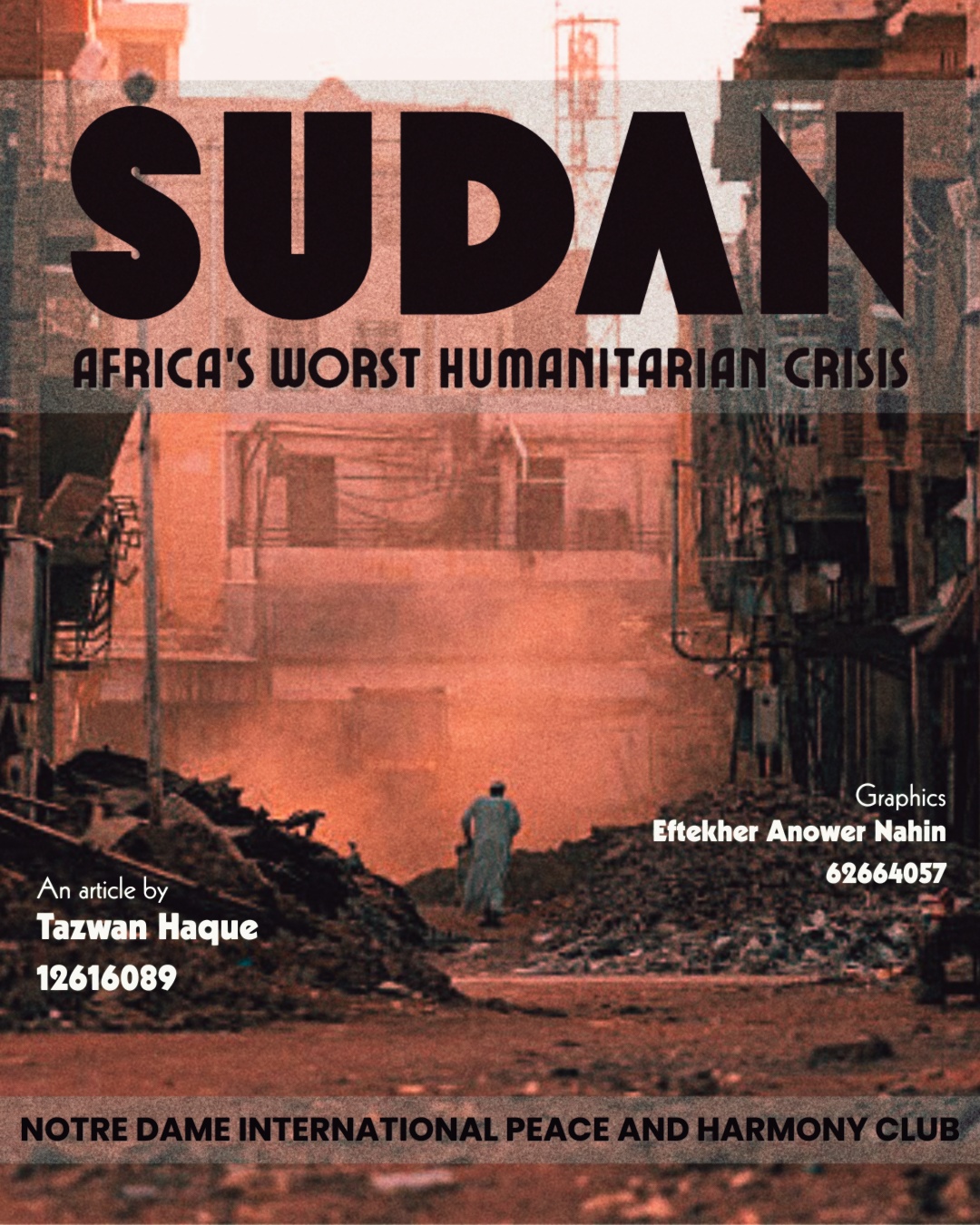
Since the redeployment of the RSF in 2023, tensions began to rise. Shootings were first sighted on 15 April 2023 despite no clear evidence of who started it. The RSF swiftly took control of Khartoum, the capital of Sudan, driving away Gen Burhan and his army to place their headquarters in Port Sudan, beside the Red Sea. Although they took back Khartoum in 2025, the city was left in shambles with government ministries, banks and towering office blocks burned to the ground. Hospitals and clinics were also bombarded, sometimes with patients inside.
On the other side, a major urban city of Darfur, El-Fasher, fell to the RSF in late October 2023. Since then, people have been fleeing the city which has been laid under siege, cutting off all forms of food and medicine supply. Even a brick wall has been made across the city to hide the atrocities inside. The RSF also hit the nearby Zamzam displacement camp, tortured men and women, killed people in mass and even raped young women and children, leading to a staggering 780,000 Internally Displaced Persons (IDPs) with a total of around 10 million IDPs across Sudan.
Currently, over 30 million Sudanese are in need of humanitarian assistance, among which more than 15 millionconstitute of children and estimates as high as 150,000 deaths have been recorded. According to a May 2025 UNICEF report, over 23,000 suspected cholera cases have been reported across 13 states; Khartoum with the largest numbers. A funding gap of over USD 756 million lingers in contrast to the 2025 UNICEF appeal of USD 1 billion. Recent satellite images even show a lake of blood across sands in El-Fashir indicating the brutal killings done by the RSF.
INTERNATIONAL INVOLVEMENTS
The conflict is not simply a local internal matter, but rather a part of broader geopolitical conquest. External involvement has prolonged the conflict, as nations appear to be hedging without coming forward to quickly establish peace. The UNSChas an arms embargo in the Darfur region, while other UN bodies like the OCHA, HRW, UNICEF, etc. have carried out various operations in Sudan.
In September 2025, the US joined with Saudi Arabia, the UAE and Egypt to propose a "roadmap" for Sudan: a three-month humanitarian truce, then a permanent cease-fire, then a nine-month transition to civilian rule. The US has also condemned RSF and labelled them as conducting genocide, consequently imposing sanctions on Gen Dagalo and his affiliate companies, including those based in UAE.
Russia, on the other hand, has vetoed a draft UNSC resolution calling for a ceasefire in November 2024, linking it to its involvement with the RSF. Reports even suggest arms supply to the RSF via Wagner and in collaboration with the UAE to protect its strategic interest in the Red Sea. Even Ukraine is alleged to have sent militants to Sudan to fight against the Wagner. While Turkey covertly supplies weapons to the SAF, Egypt and Saudi Arabia have politically and militarily supported the SAF considering Egypt's concerns over the Nile River and Saudi's concerns over the Red Sea coast.
But, the country with the most disputable involvement in this conflict is the United Arab Emirates (UAE). Multiple independent investigations suggest UAE's direct relations with the RSF, including supply of arms and weapons flows, mainly through Chad, logistic support and investment interests. Since the formation of the RSF, the UAE has always been on good terms with Hemeti, which can be further proved by frequent gold smuggling from Sudan to UAE by the RSF controlled gold mines in return for ammunition and investments.
All these external and internal issues are only piling up one after another with nobody to advocate for peace in Sudan, leaving an unimaginably huge population into an urgent humanitarian crisis. So, can dialogues finally bring harmony to this region or is this conflict going to be the cause of yet another partition of Sudan?
SOCIAL MEDIA POST CAPTION
Behind the worst humanitarian crisis Africa has ever seen, lies the brutal repercussions of the current Sudanese civil war.
The intense war that has completely devastated Sudan since 2023 primarily roots from a nasty power struggle between two military groups in the country; the Sudanese Armed Forces (SAF) and the Rapid Security Forces (RSF). This contest over the country's authority has led to the misery of millions of Sudanese people, consequenting to an urgent humanitarian crisis that needs international attention.
Although efforts for mediation have been taken, the intervention of other countries in this conflict, chiefly the United Arab Emirates (UAE) has prolonged the issue, rather than solving it, leading the whole situation into a stalemate.
WRITTEN BY TAZWAN HAQUE 12616089 AND DESIGNED BY EFTEKHER ANOWER NAHIN 62664057