The Grandest Institutional MUN
Has Spoken
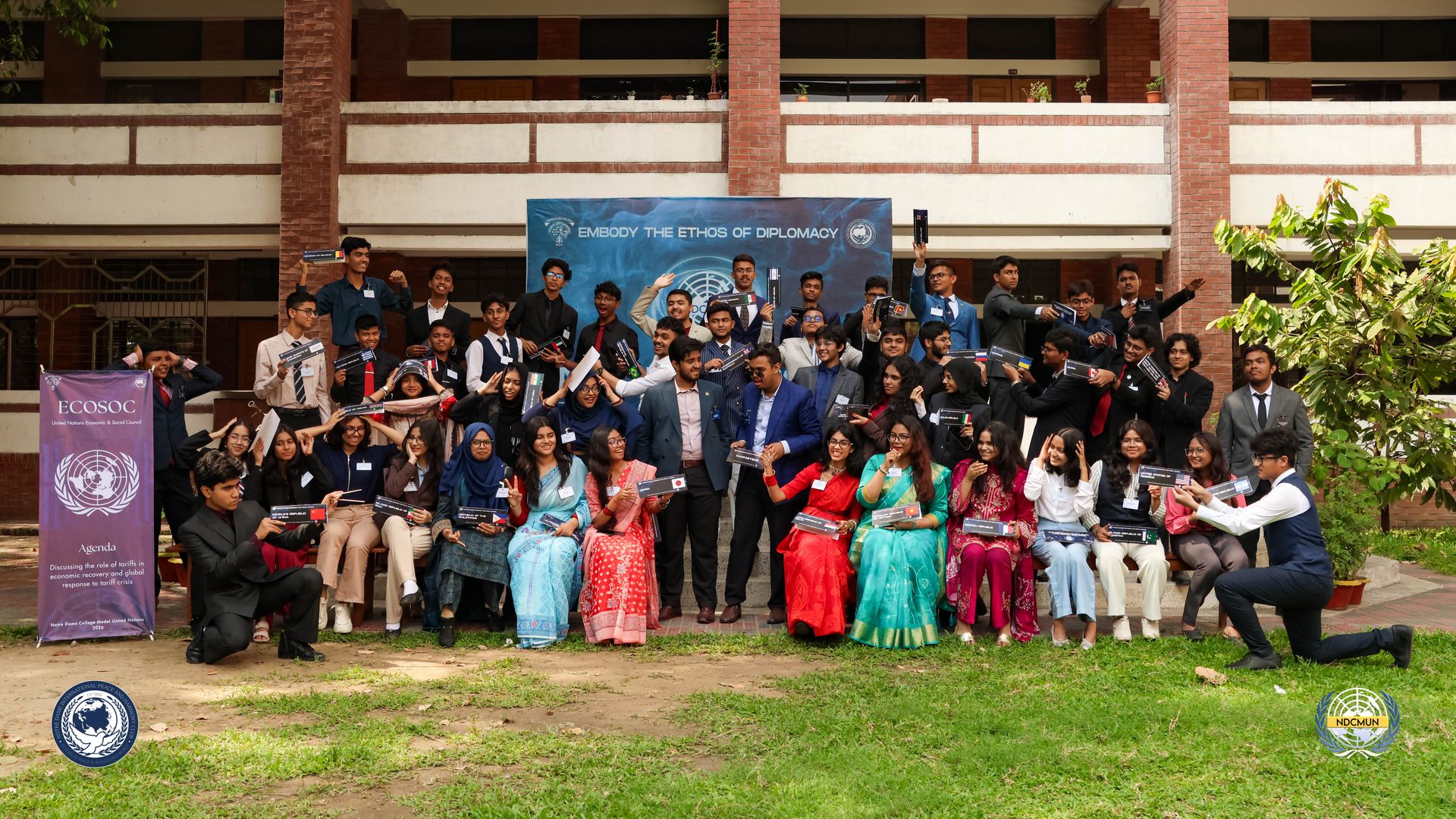
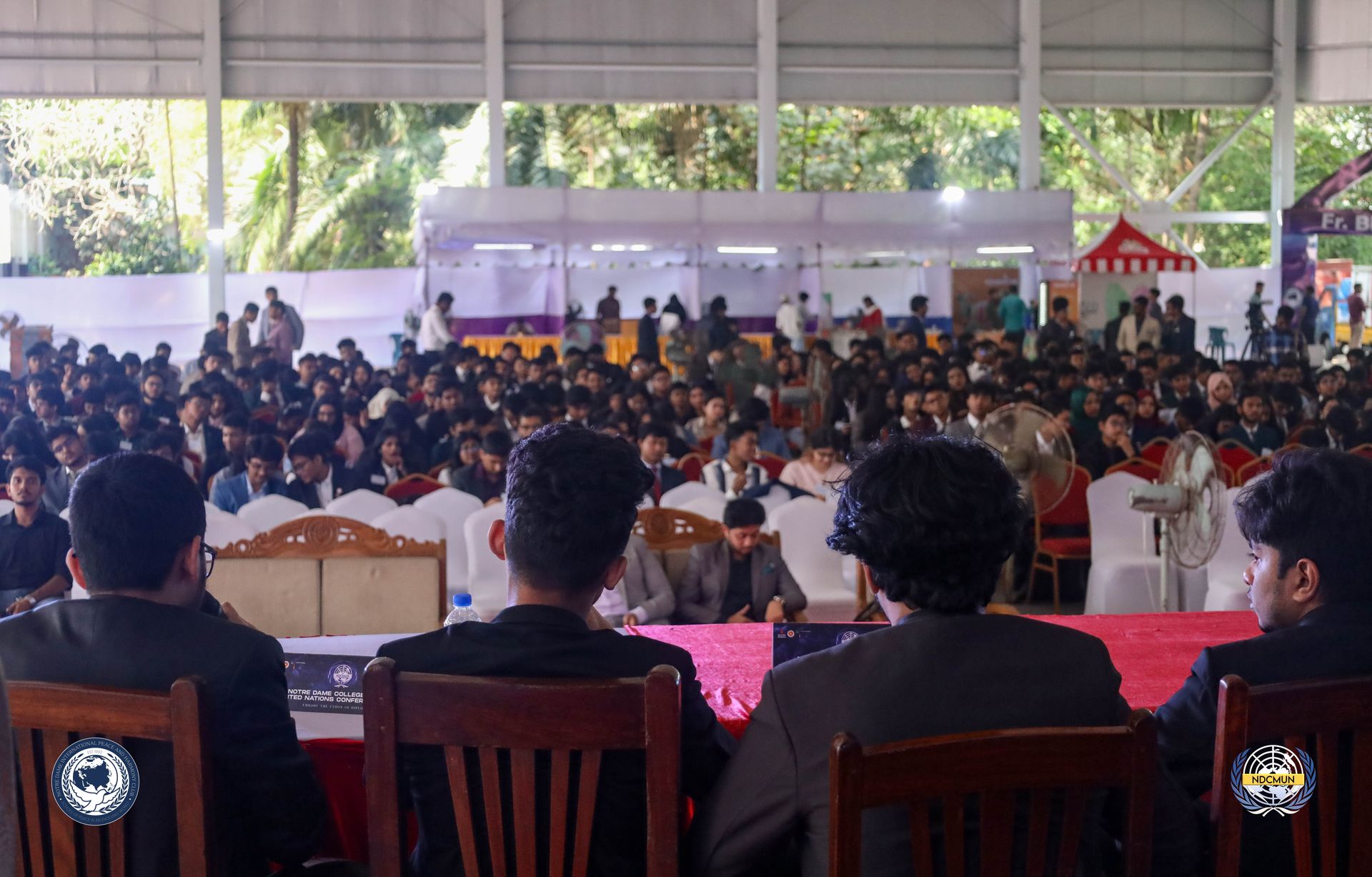
NDCMUN'26 concludes its 8th edition — 430+ delegates, 12 committees, three days of debate that redrew the map of collegiate Model UN in Bangladesh.
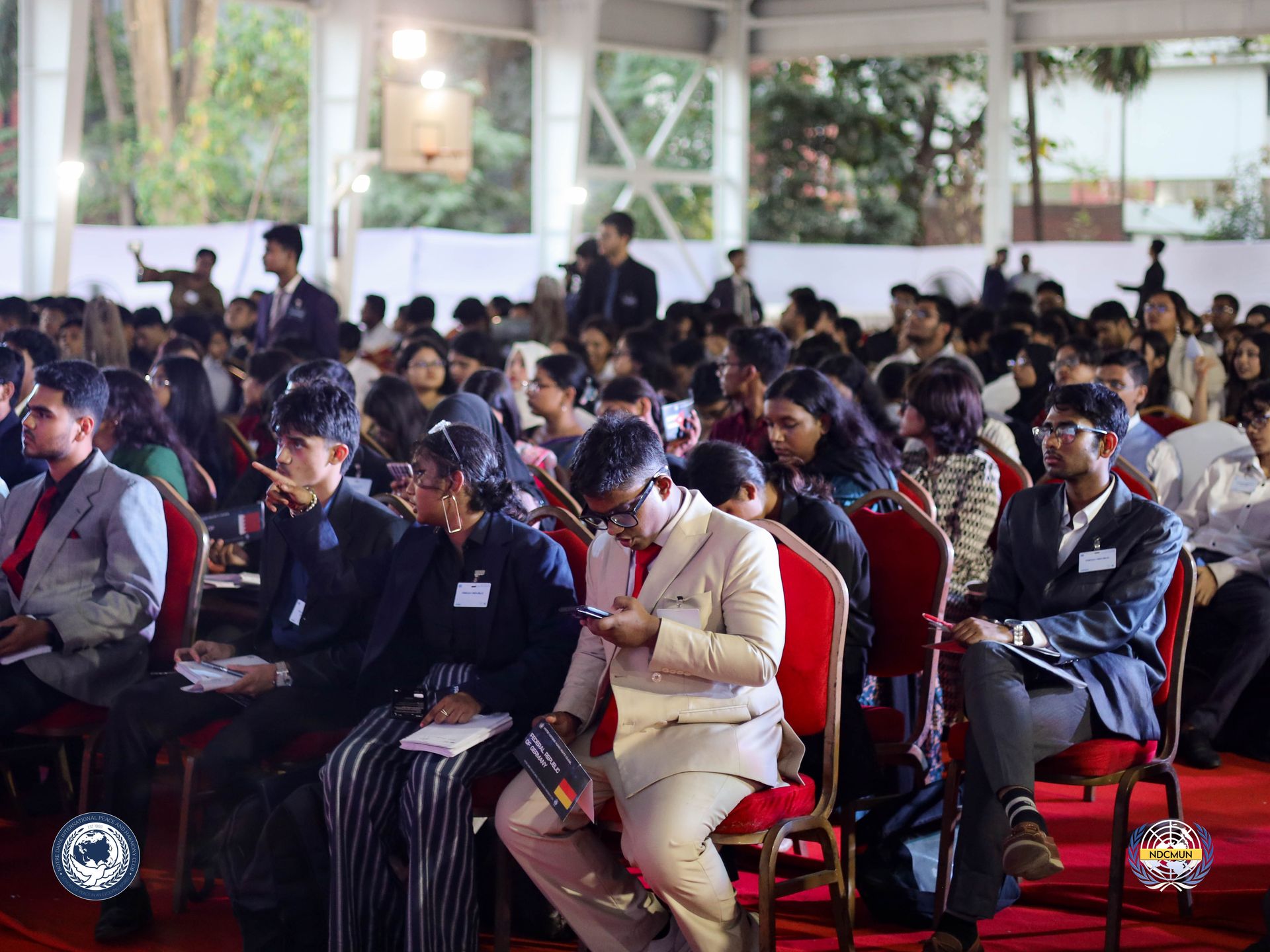
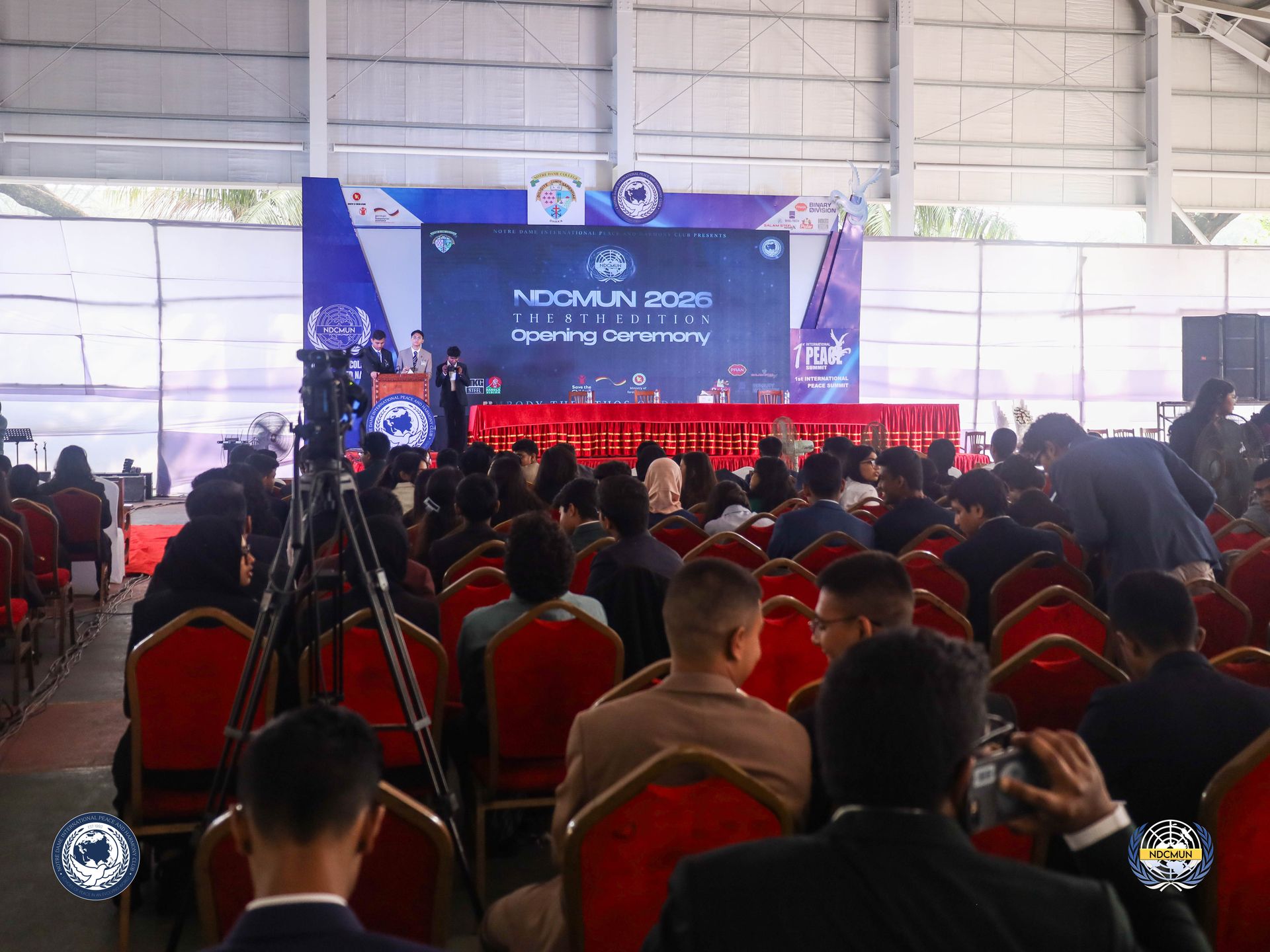
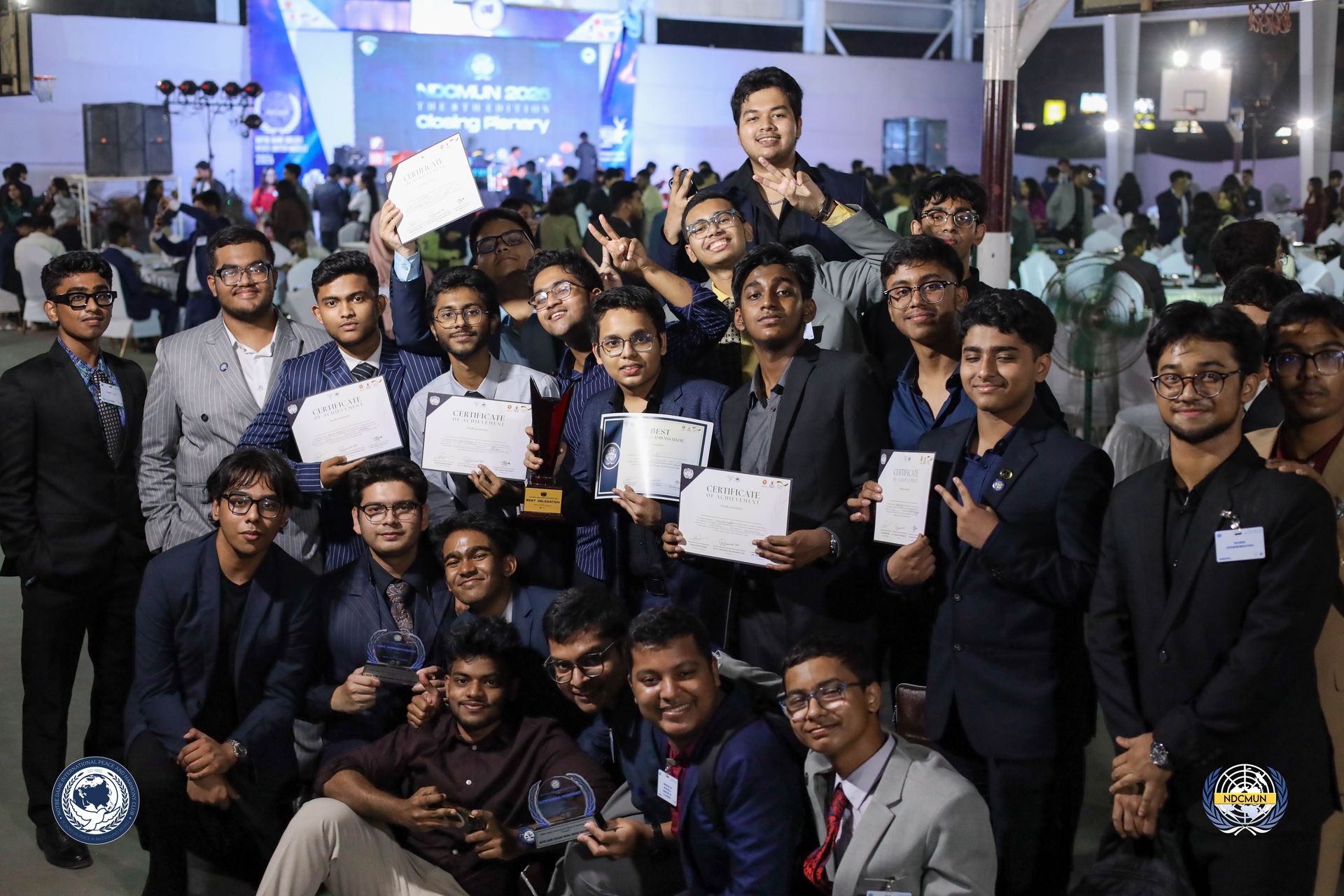
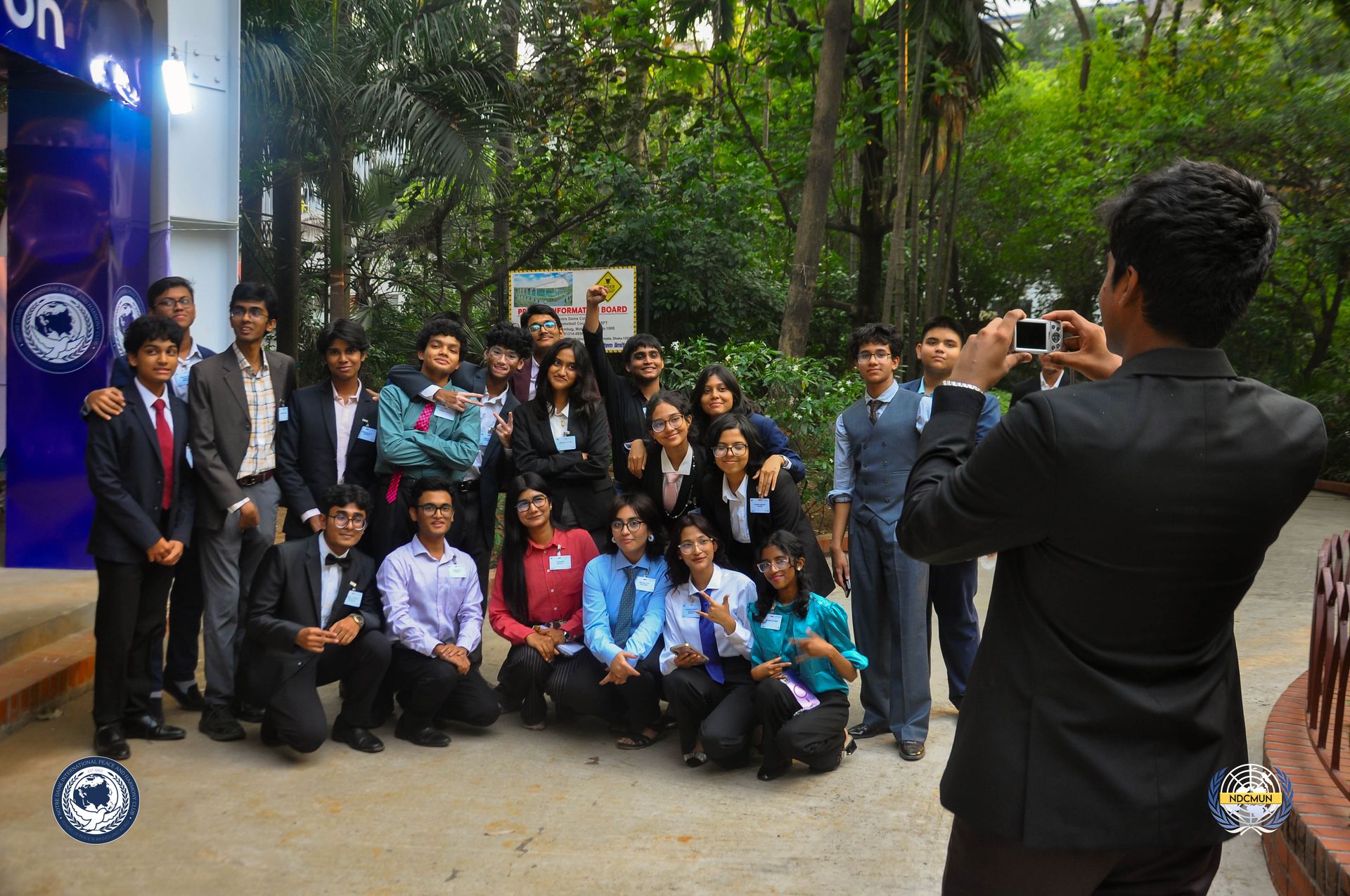
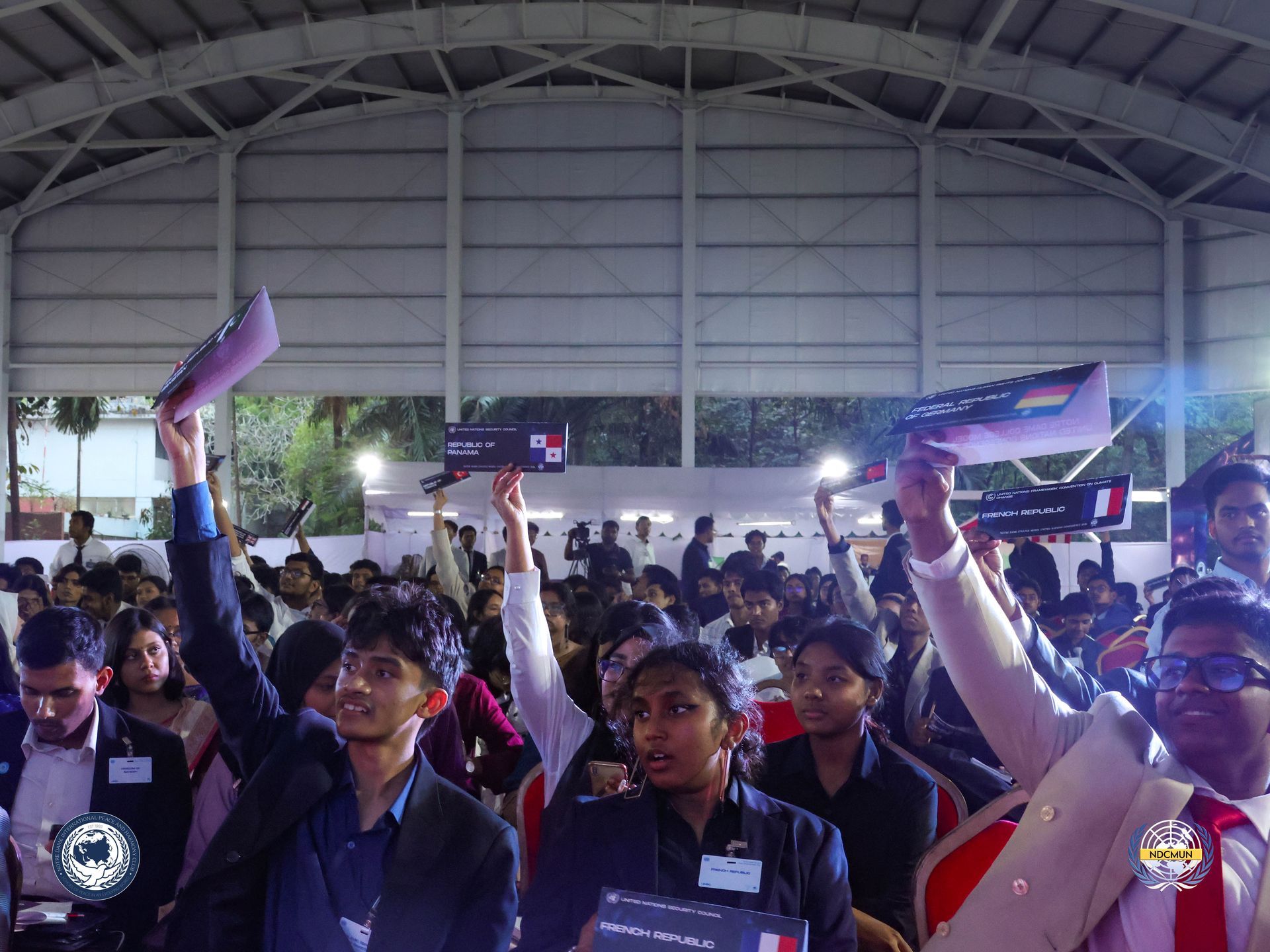
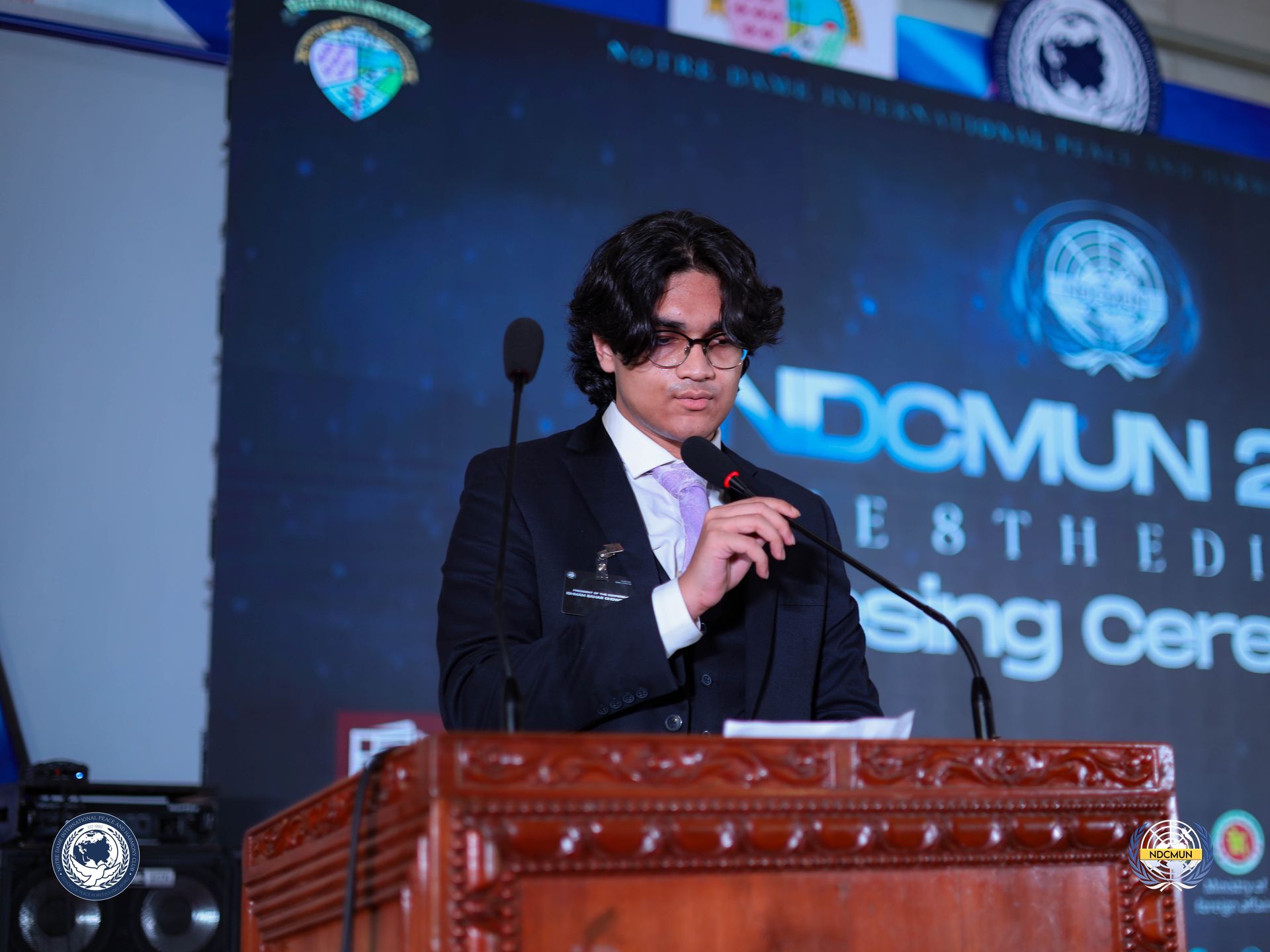
When the gavel fell for the final time at Notre Dame College Model United Nations 2026, it marked the close of what many delegates are already calling the defining institutional MUN of a generation. The 8th edition of NDCMUN drew over 430 participants from across the country — and across three days of relentless debate, crisis sessions, courtroom drama, and historic charter-writing, it did not disappoint.
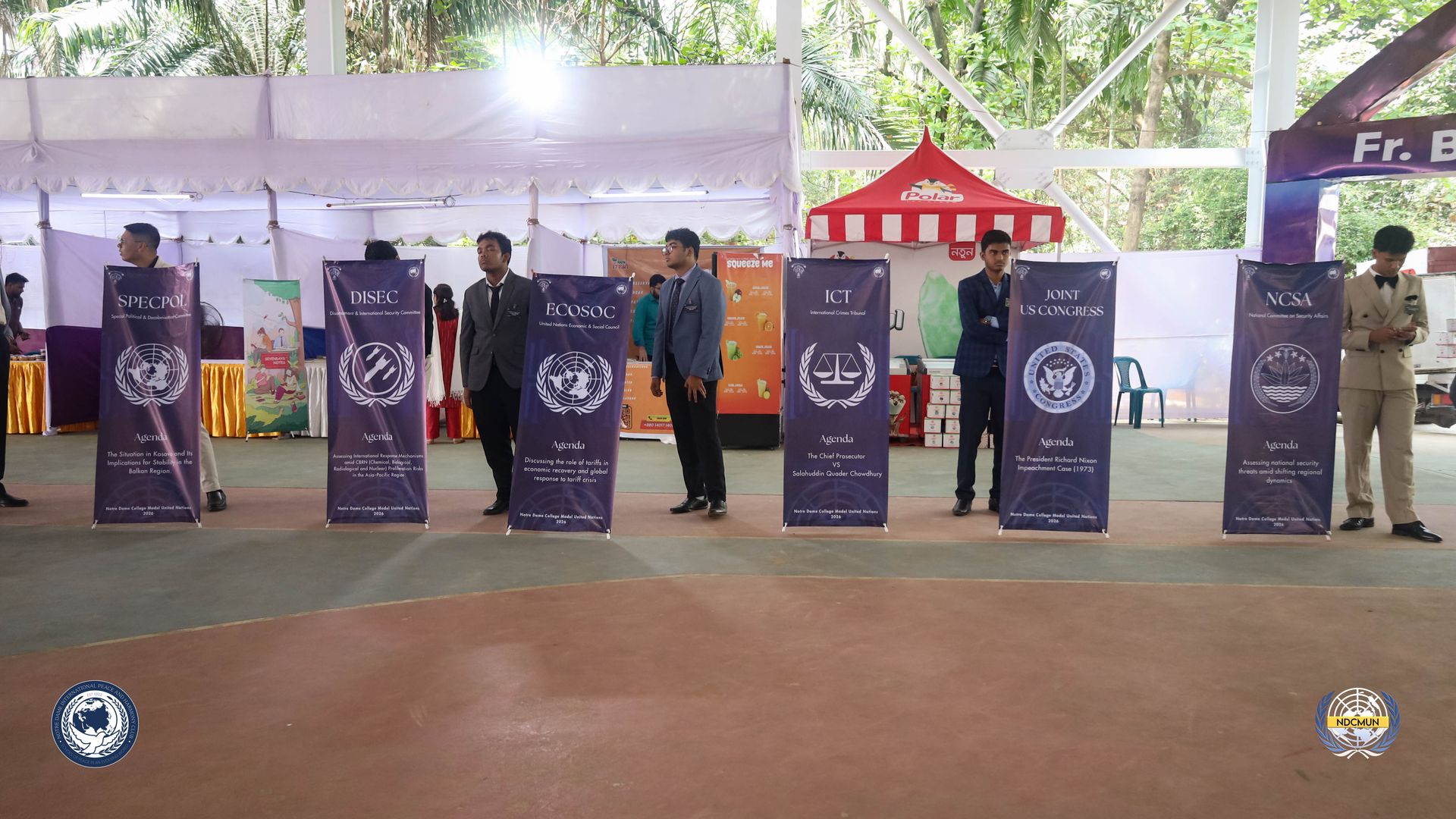
Twelve committees. Twelve agendas spanning everything from tariff wars and climate finance to the 1945 founding of the United Nations itself. From the moot courtroom of the International Crimes Tribunal to the backroom diplomacy of the San Francisco Conference, NDCMUN'26 ran the full spectrum of what Model UN can be — and then pushed further. The academics were, by nearly universal delegate consensus, absolutely astounding.
This is the story of how it unfolded.
If NDCMUN'26 had a political heartbeat, it pulsed loudest in ECOSOC. The committee convened against the backdrop of the sweeping tariff regime introduced by the United States since 2025 — and delegates wasted no time making their positions known. The Russian Federation and the Eastern Bloc came out swinging, levelling pointed accusations that Washington's trade policies amounted to a deliberate attempt to engineer a global recession.
Day one grounded delegates in the stakes with a structured case study on the agenda's real-world dimensions. The second day shifted gears dramatically with a live crisis session — and it was Iran, Pakistan, and China who stepped up, forging a Joint Directive that steered the room back from the brink. The final day brought two competing Draft Resolutions: one authored by China and Saudi Arabia, another co-authored by the UK and Canada. Despite Britain's spirited attempt to amend the China–Saudi resolution into something more palatable to the Western bloc, it held — and passed. A decisive win for the Eastern coalition.
"The Russian Federation accused the USA of trying to bring about a global recession — and the chamber never quite recovered its composure."
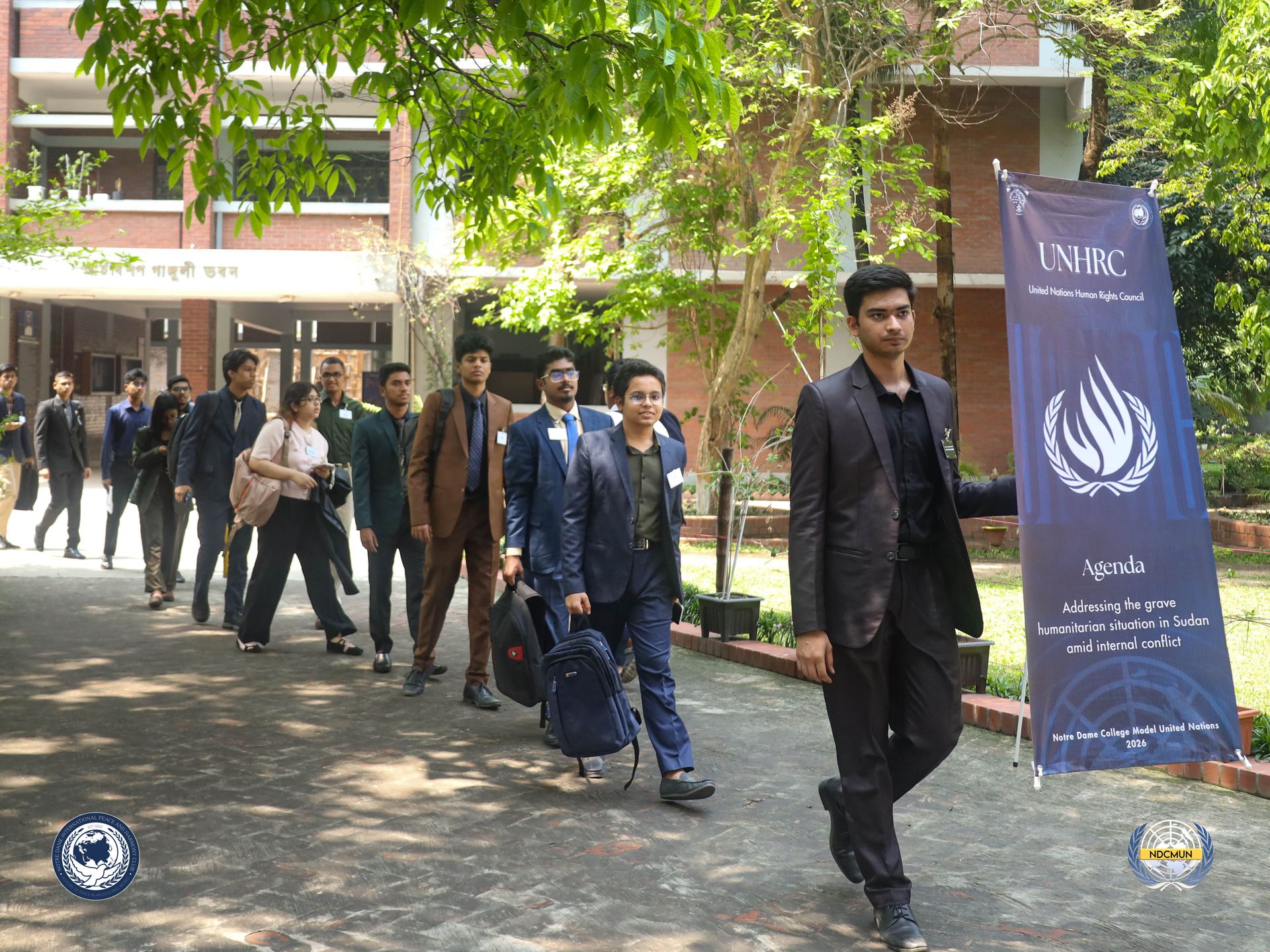
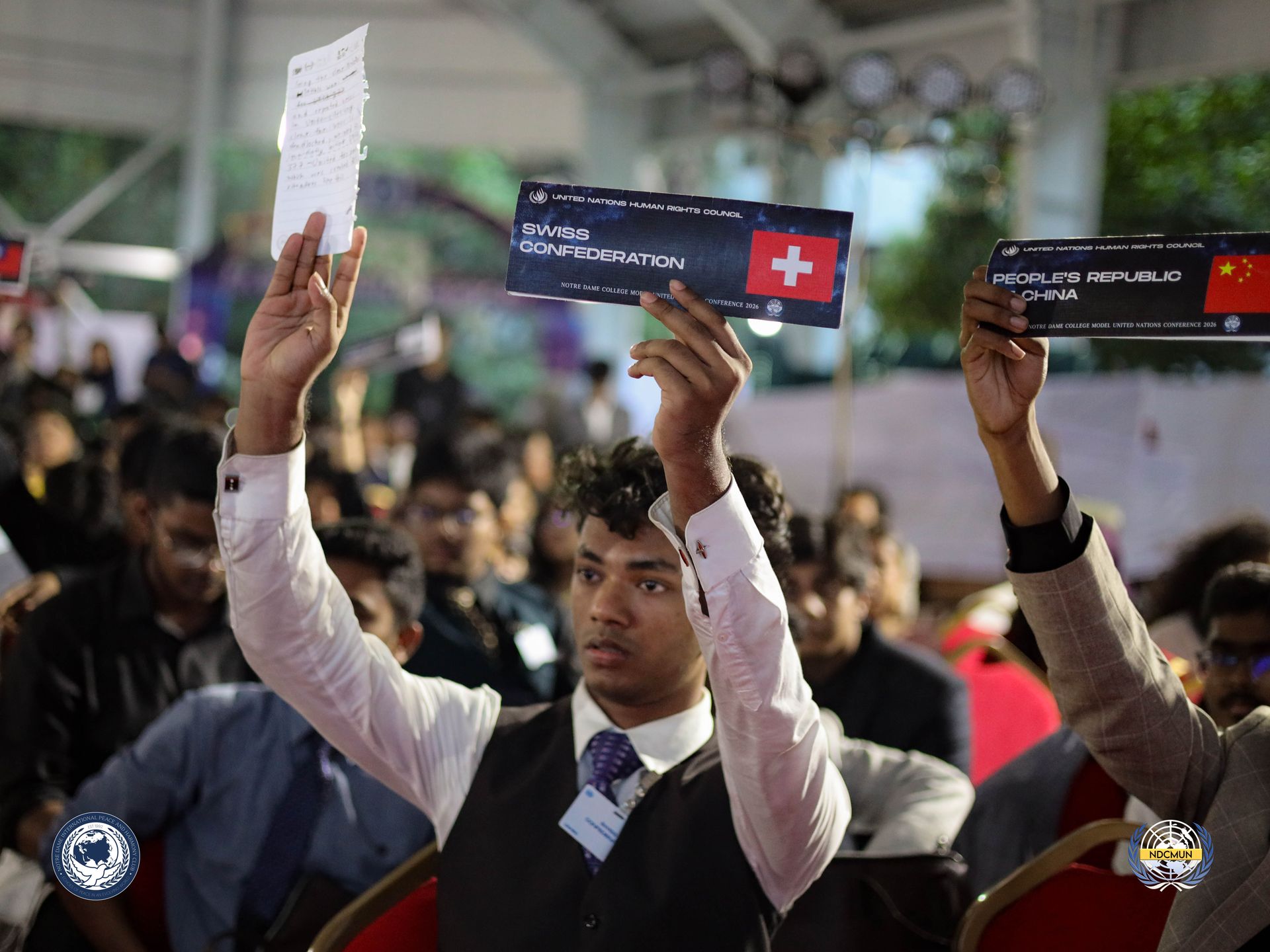
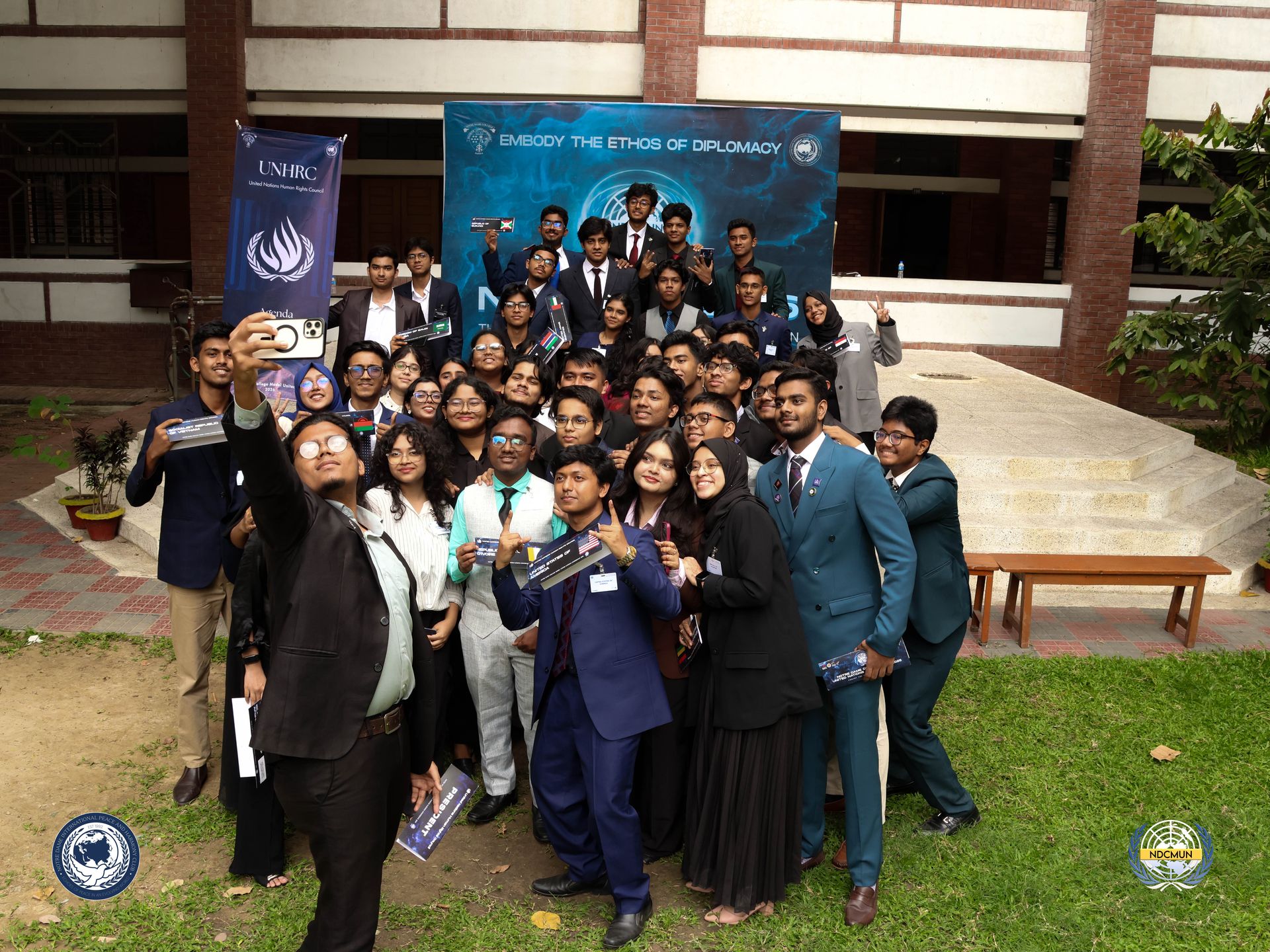
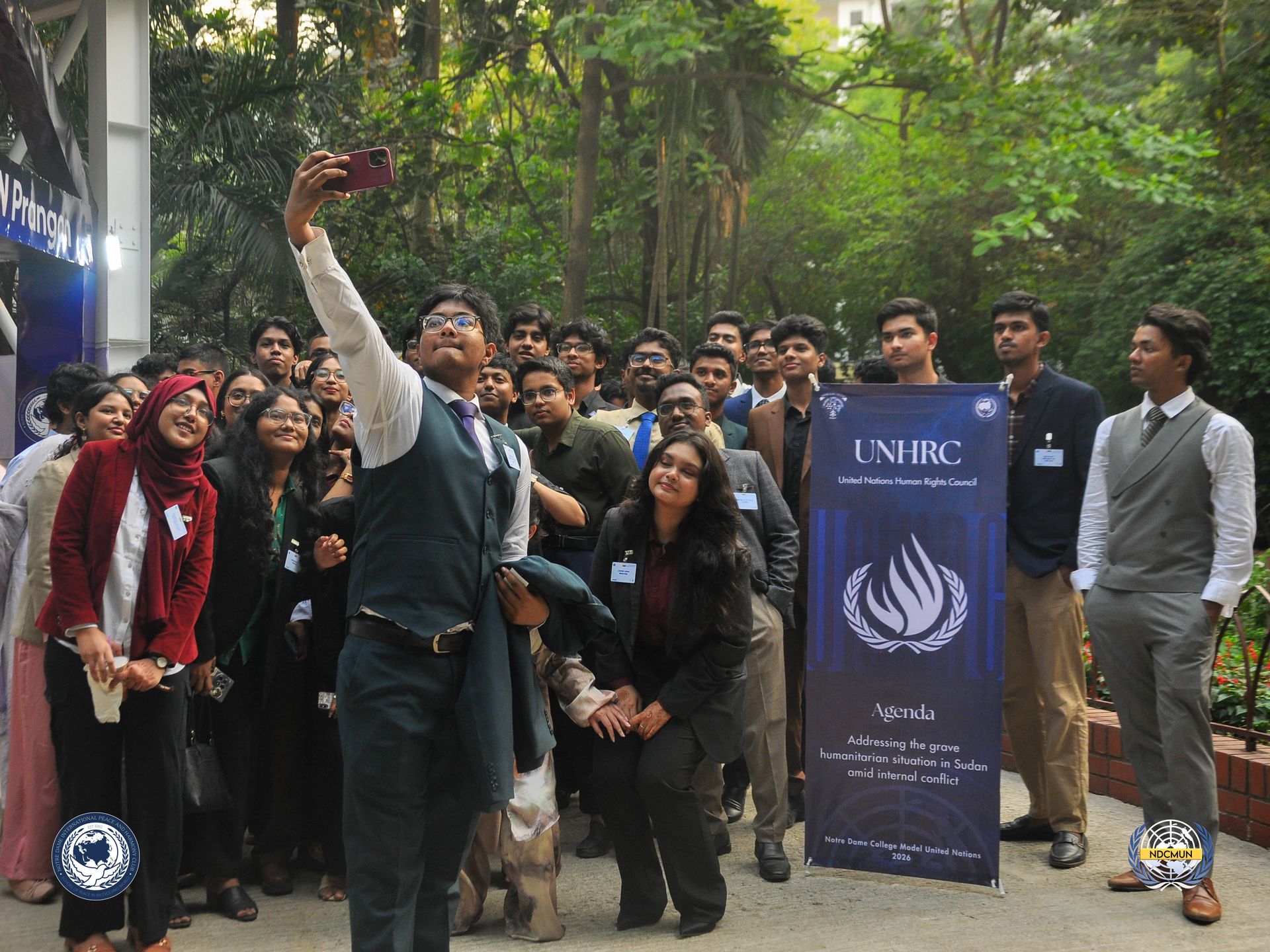
With 45 delegates assembled and one of the world's most urgent humanitarian crises on the table, the UNHRC became a chamber of genuine moral weight. Sudan's ongoing internal conflict — its staggering human cost, its fractured accountability mechanisms — drove three days of exhaustive moderated sessions and consultations, with standout contributions from the Swiss Confederation, UAE, Sudan, USA, and the Democratic Republic of Congo.
The culmination was a landmark Draft Resolution co-sponsored by Switzerland, China, and the DRC, backed by over 26 signatories. At its heart, Annex I laid out six robust sections under the Integrated Reform Points for the Independent International Fact-Finding Mission for Sudan — covering accountability mechanisms, a Survivor and Civil Society Chamber, Geneva-based evidence preservation units, and comprehensive implementation oversight. It passed as a testament to what careful multilateral negotiation can produce.
The OIC's General Speakers' List was one of the most incendiary of the conference. Delegations from across the Muslim world traded blame and pointed accusations over the "current state of the Ummah" — the speeches were heated, charged, and at times deeply personal in their geopolitical framing.
Day two cooled into structured negotiation, with three consultations across formal and informal sessions. Day three opened with the first Draft Resolution — co-authored by Saudi Arabia, Türkiye, Azerbaijan, and Pakistan — but it failed to secure a majority and was rejected. A fresh twenty-minute unmoderated caucus produced a second resolution, this time led by Jordan. After a tense amendment session, Jordan's resolution crossed the line and passed — a reminder that in multilateral diplomacy, adaptability consistently outperforms raw firepower.
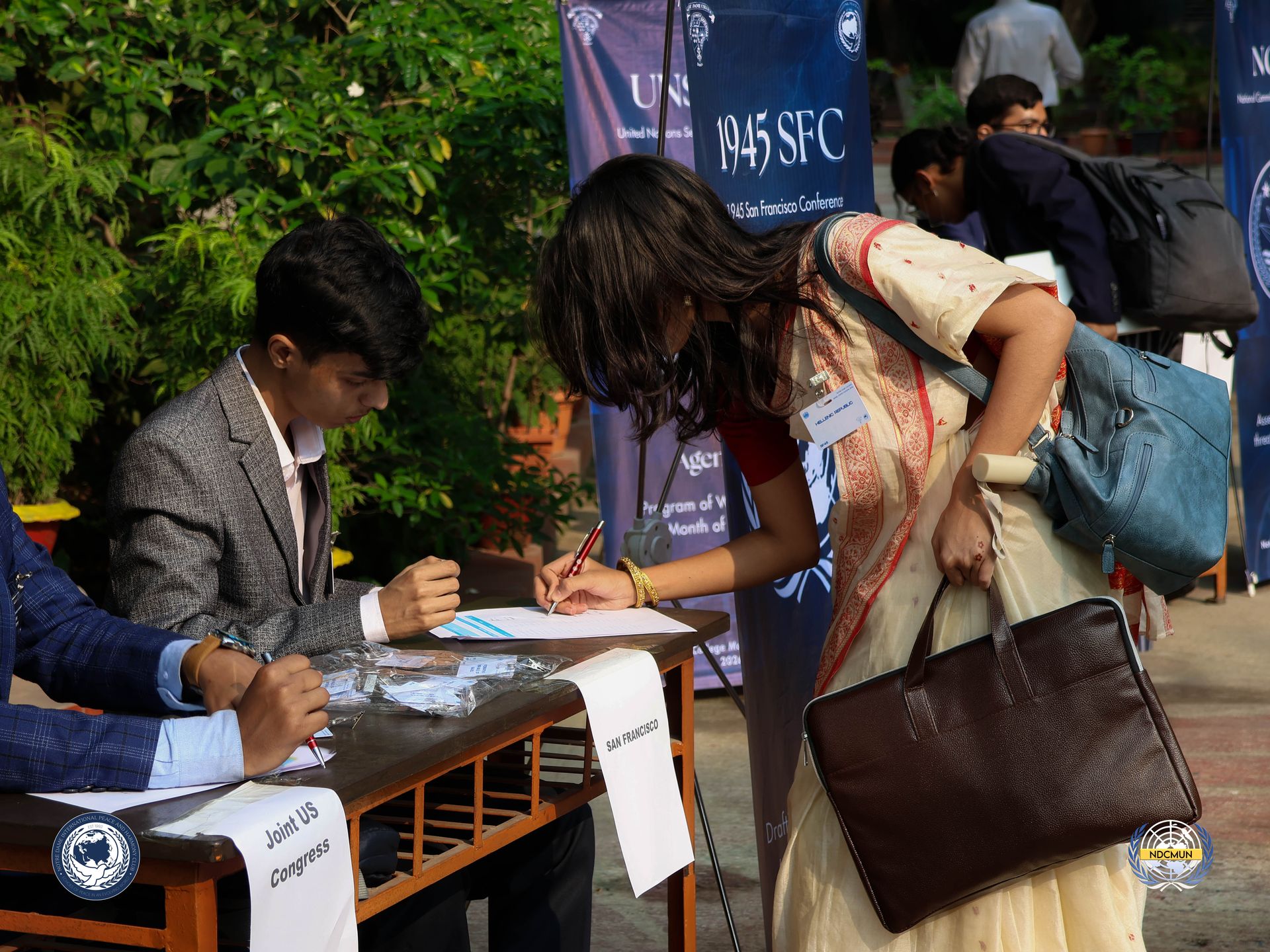
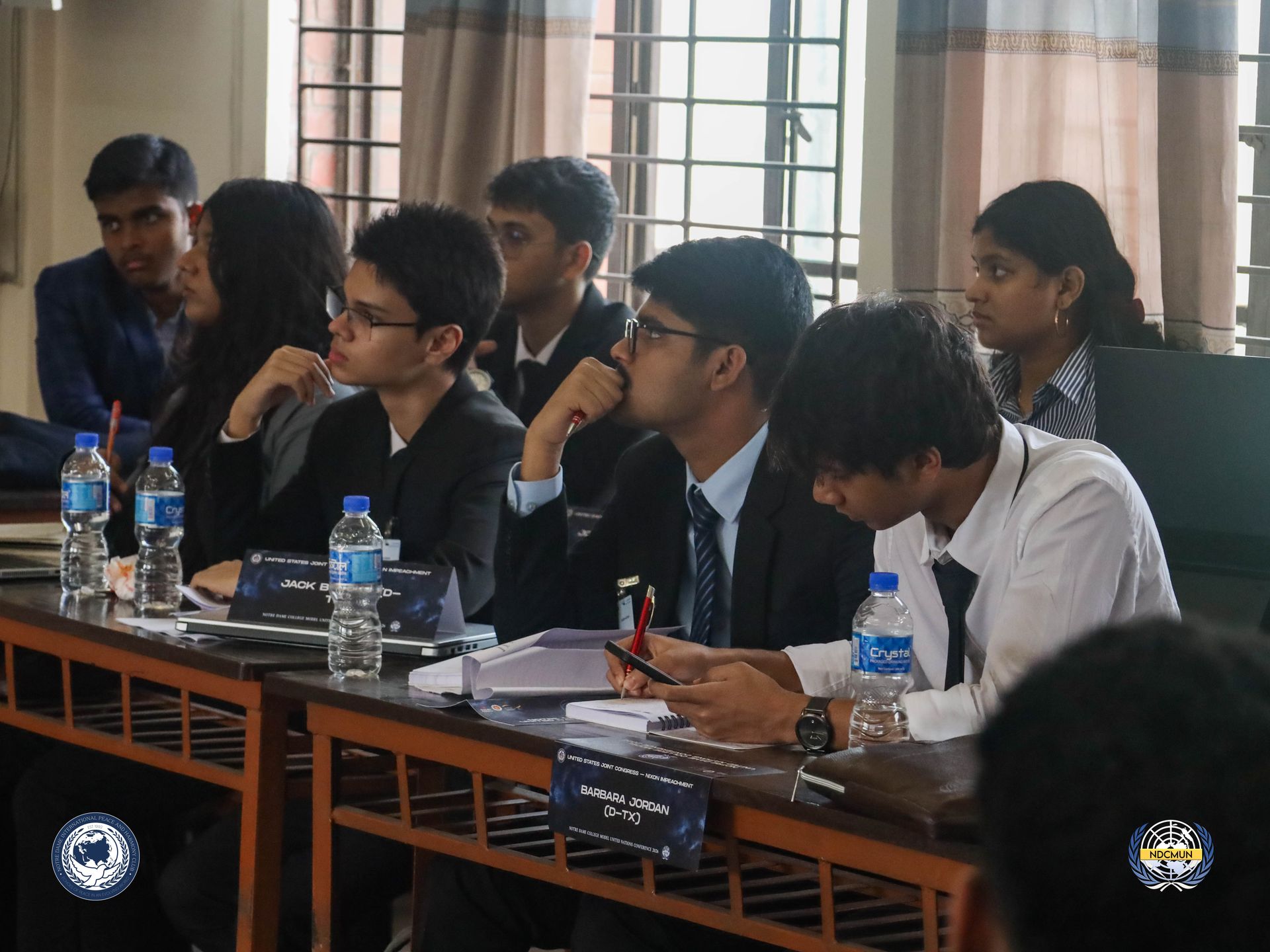
Forty members of Congress. One president. One constitutional crisis. The Joint US Congress at NDCMUN'26 was a full historical immersion — delegates locked into the world of 1973, bound by its timeline, its evidence, and its political fault lines. Republicans and Democrats clashed in what observers called "heated and fruitful" congressional debate, the kind that made the chamber feel less like a simulation and more like a revival of one of American history's most consequential moments.
After exhaustive hearings — witnesses examined, evidence scrutinised, testimonies cross-checked — the Congress reached consensus. Four Articles of Impeachment were drafted and adopted, sealing the fictional fate of the 37th President of the United States. The result was historically faithful, dramatically satisfying, and a showcase of how a well-run specialised committee transforms procedural rigour into genuine theatre.
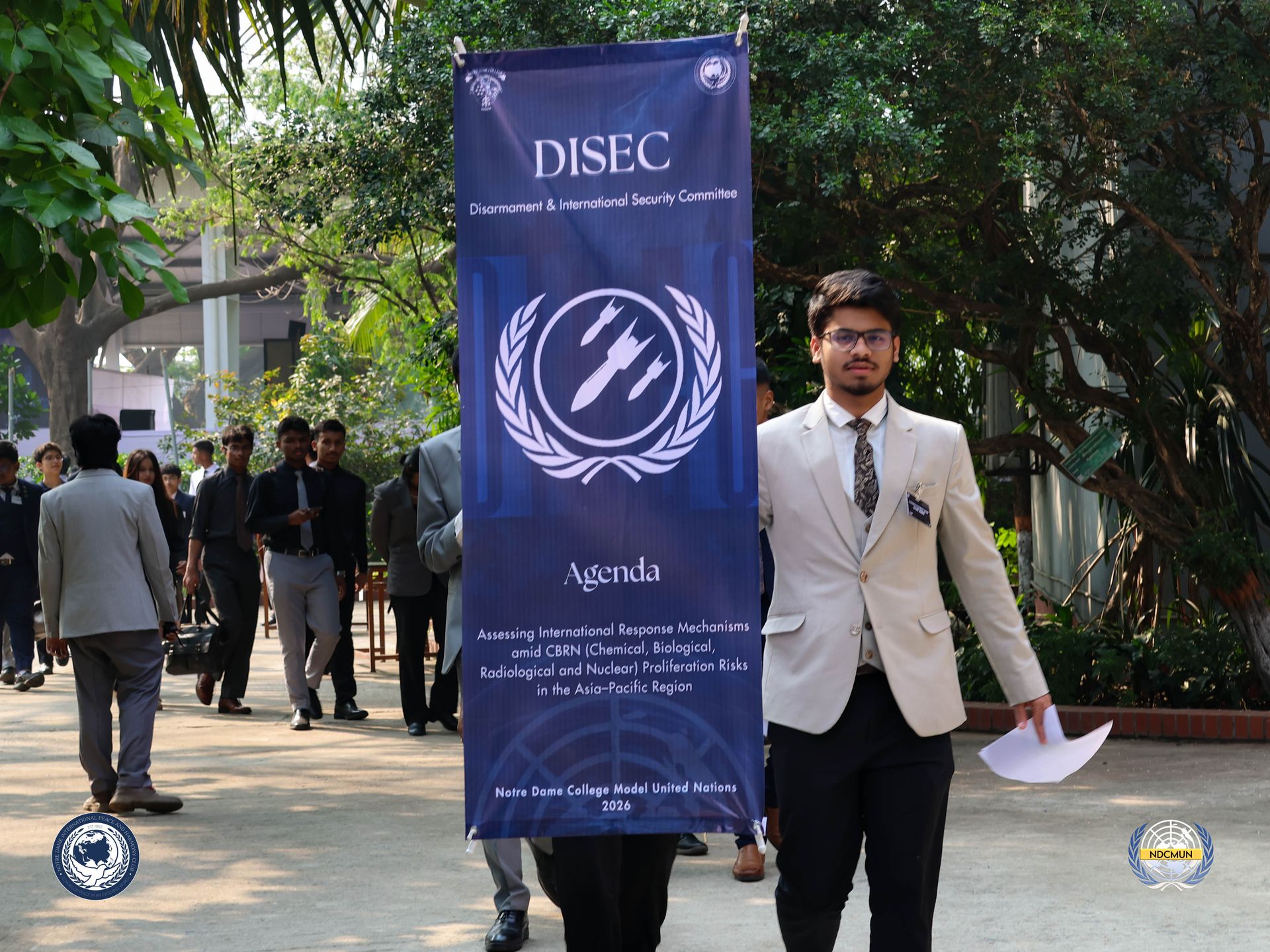
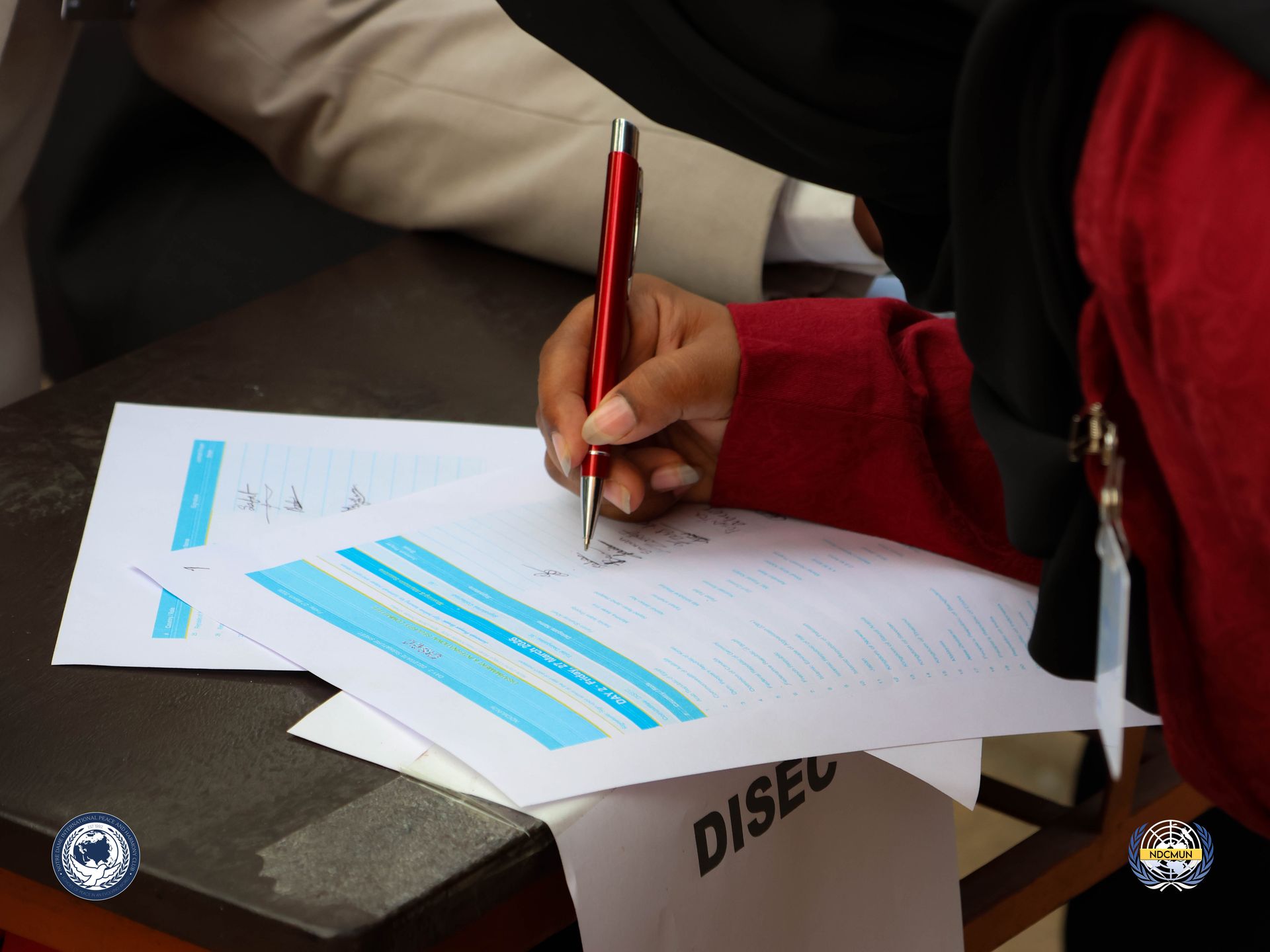
DISEC took on one of the most technically demanding briefs of the conference — chemical, biological, radiological, and nuclear threats across the world's most geopolitically volatile region. The General Speakers' List immediately exposed fault lines: nuclear-armed states faced sharp scrutiny from NPT signatories, with North Korea and Pakistan drawing particular attention from the floor.
A crisis injection on day two — a simulated radiological incident in the South China Sea — galvanised the committee, pushing delegates into rapid-fire unmoderated caucuses. China, Japan, and Australia emerged as the dominant bloc leaders. The final day produced two competing Draft Resolutions: one from the United States and Australia, another from China and Russia. A contentious amendment session produced a merged text incorporating regional verification mechanisms and an early-warning protocol — passed with a strong majority, and widely considered one of the conference's most substantive legislative outputs.
The UNFCCC committee demanded more technical literacy than perhaps any other room at NDCMUN'26 — and its delegates rose to the challenge. The agenda centred on translating the political promises of COP28 and COP29 into real financial architecture: disbursement criteria, governance structures, and contribution thresholds under the New Collective Quantified Goal framework.
Small Island Developing States and Least Developed Countries formed a powerful coalition on day one, demanding direct access mechanisms and rejecting financial intermediaries. The EU and G77+China bloc spent much of day two in intricate contribution negotiations. On the final day, Bangladesh, the Maldives, and Germany co-authored a Draft Resolution establishing a tiered contribution model alongside an independent review board — a carefully grounded package that passed to genuine applause, and one that carried particular resonance in a conference hosted in one of the world's most climate-vulnerable nations.
"The academics were absolutely astounding — making this, by delegates' own reckoning, the grandest institutional MUN the country has seen."
The ICT was NDCMUN'26's moot court — and it proved to be among the most gripping chambers of the entire conference. The case revisited the landmark trial of Salahuddin Quader Chowdhury, charged with genocide, murder, rape, and torture committed during Bangladesh's 1971 Liberation War.
The prosecution built its case on placing Chowdhury in Raozan, Chattogram, at the time of the alleged crimes. The defence countered with witnesses and evidence claiming he was in Lahore, West Pakistan — making his presence at the scene physically impossible. But the alibi unravelled: the tribunal identified critical discrepancies between the defendant's testimony and the submitted evidence, discarding the defence's materials as forgeries and fining the defence counsel accordingly.
In their final judgement, the tribunal found it could neither fully accept nor fully reject the plea of alibi — but on the weight of the evidence, it convicted Salahuddin Quader Chowdhury of murder and rape, sentencing him to 17 years imprisonment, while acquitting him on the charge of genocide. A verdict that balanced legal complexity with moral clarity — and left the chamber in hushed reflection.
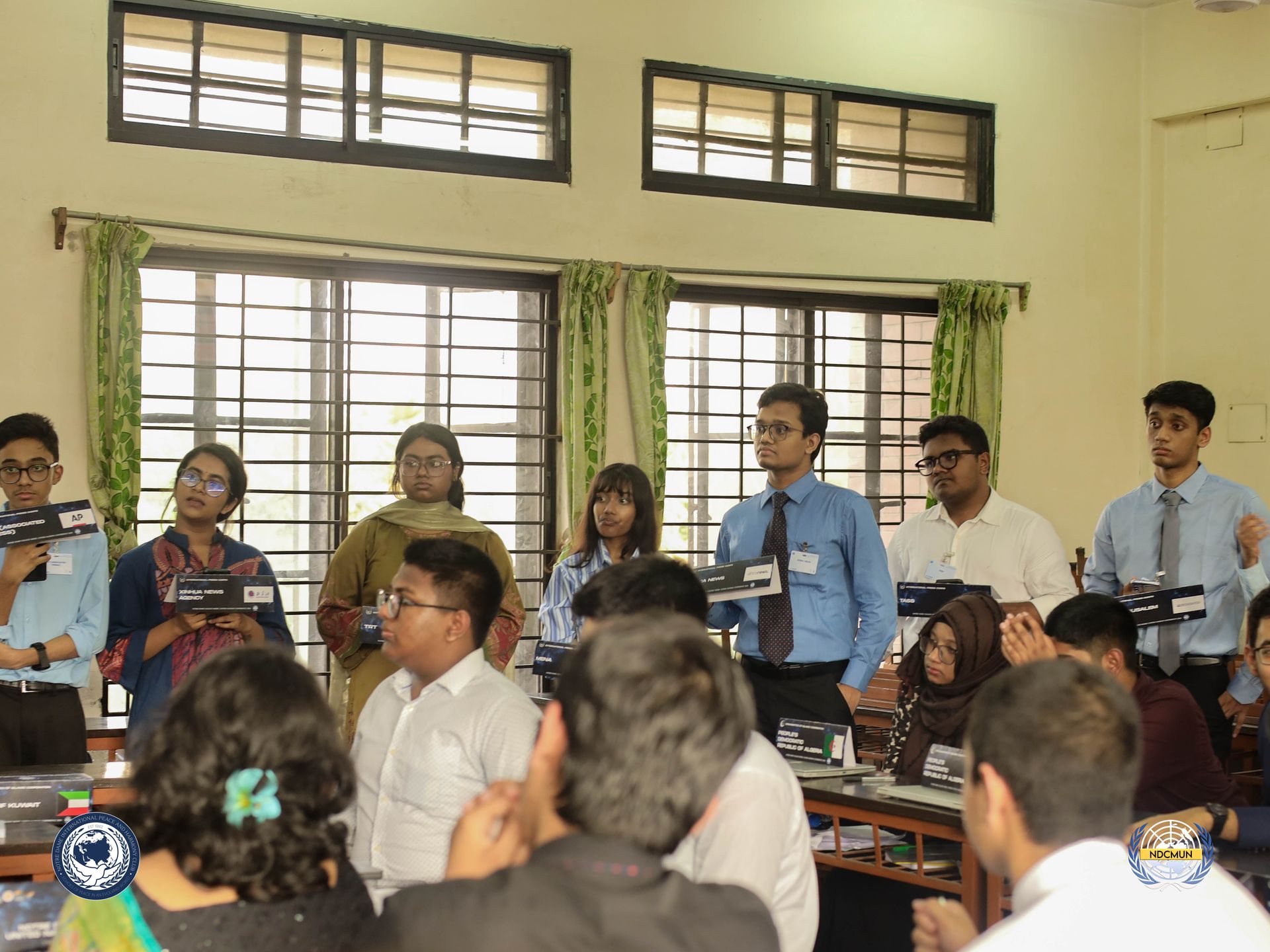
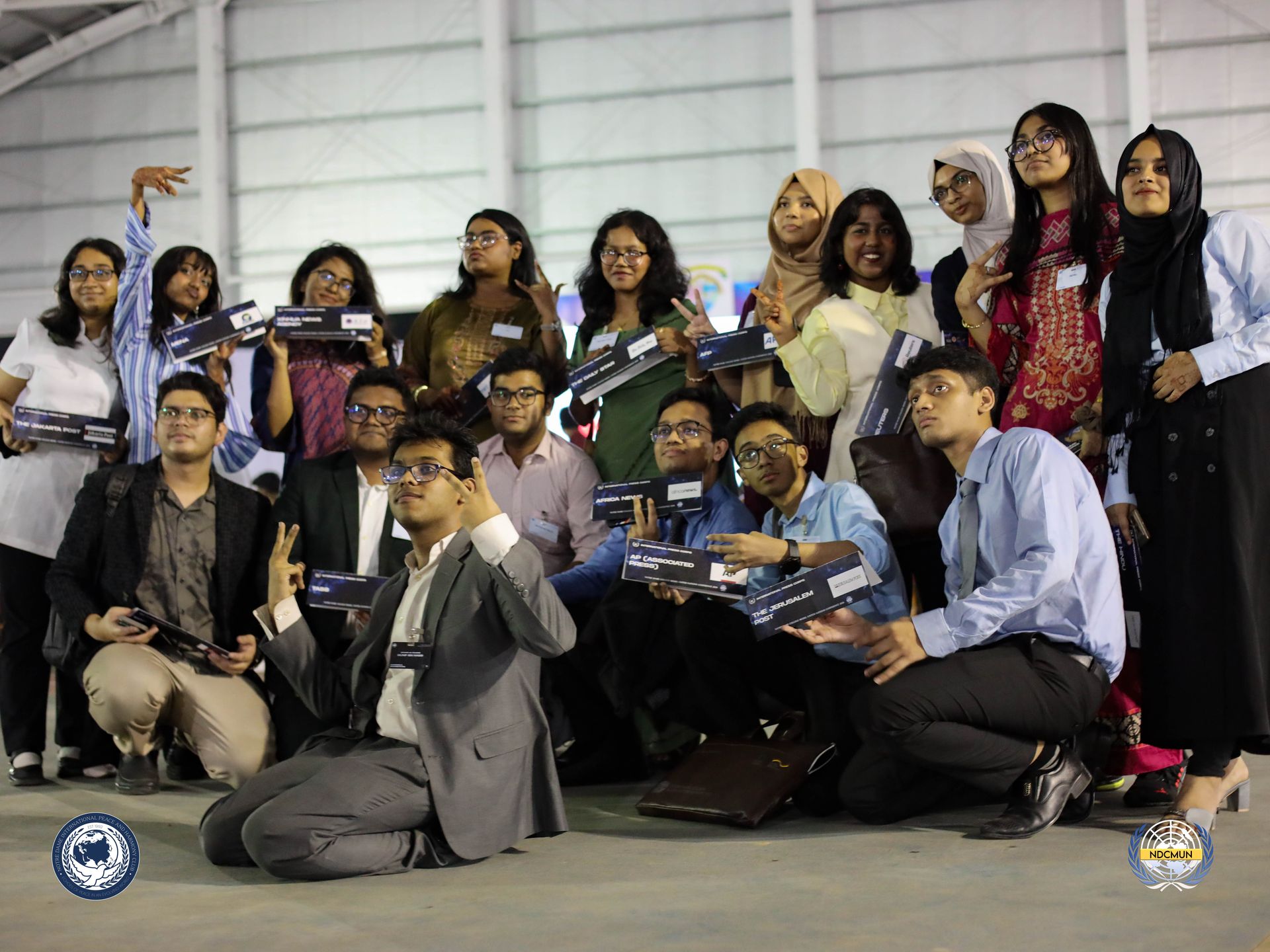
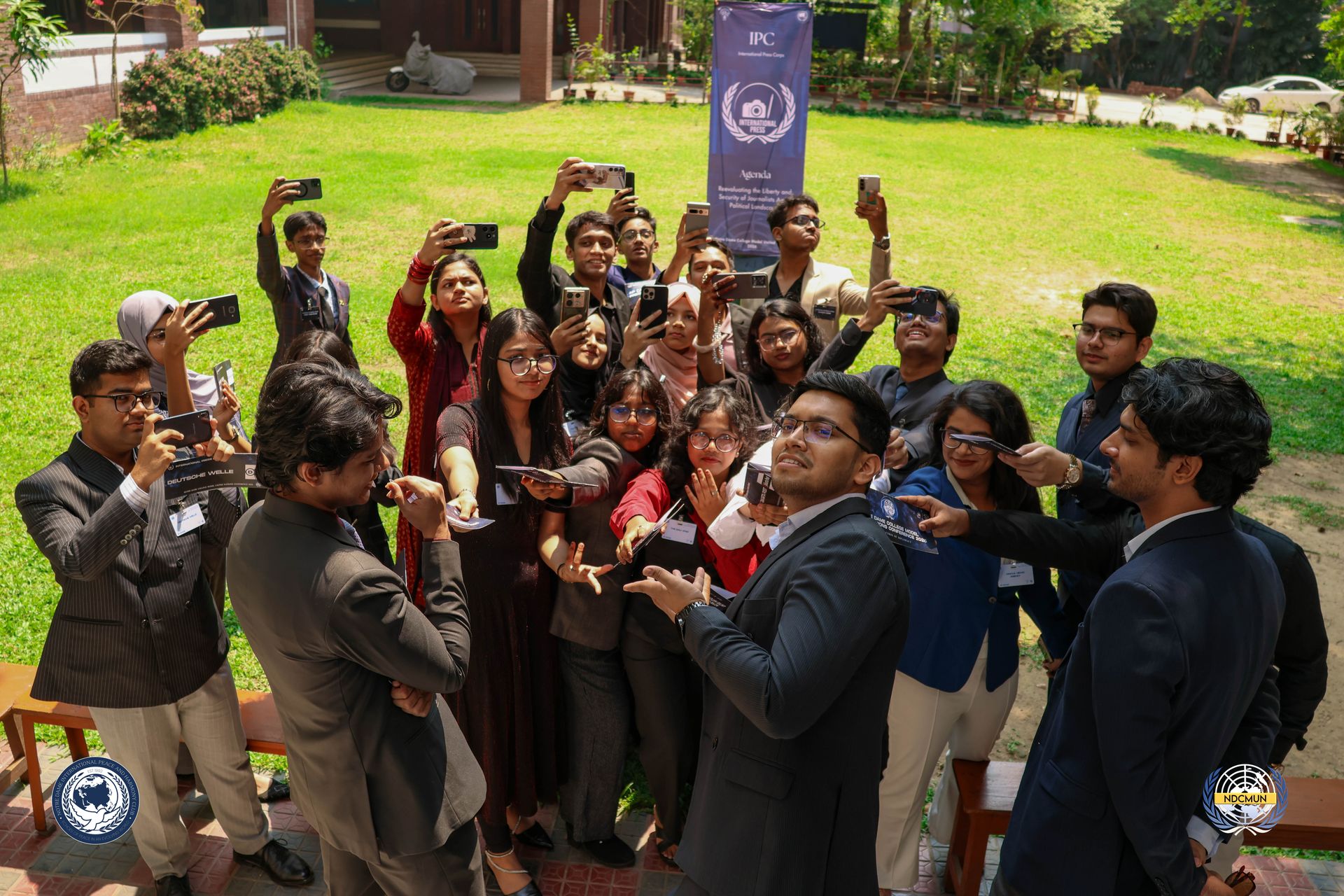
The IPC brought a singular energy to NDCMUN'26 — a chamber where free expression was both the subject of debate and its most powerful instrument. Delegates representing states with wildly divergent press freedom records clashed from the opening gavel, with Turkey, Hungary, and Egypt facing sustained criticism from Nordic delegations and Canada over their treatment of the press.
Day one's speeches drew on real-world cases of persecution, exile, and targeted killing — some of the conference's most emotionally forceful oratory. A crisis update on day two introduced a simulated abduction of a journalist covering a conflict zone, sharply intensifying the debate around state accountability and international protection frameworks. The resolution that emerged — co-sponsored by France, the Netherlands, and Costa Rica — proposed an international journalist protection registry and a rapid-response legal support mechanism. It passed by a close vote, a reflection of just how contested and consequential the question of press liberty remains.
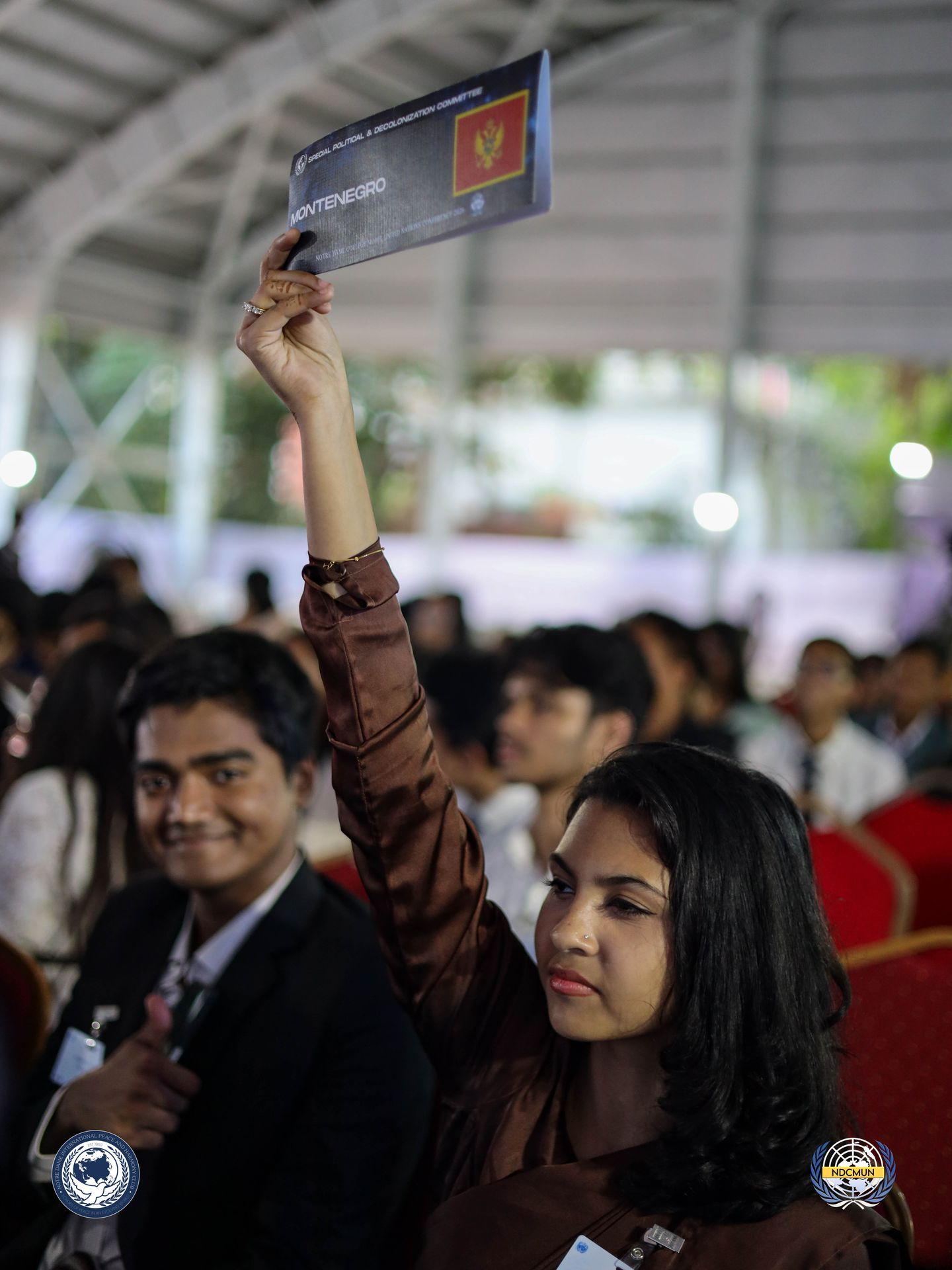
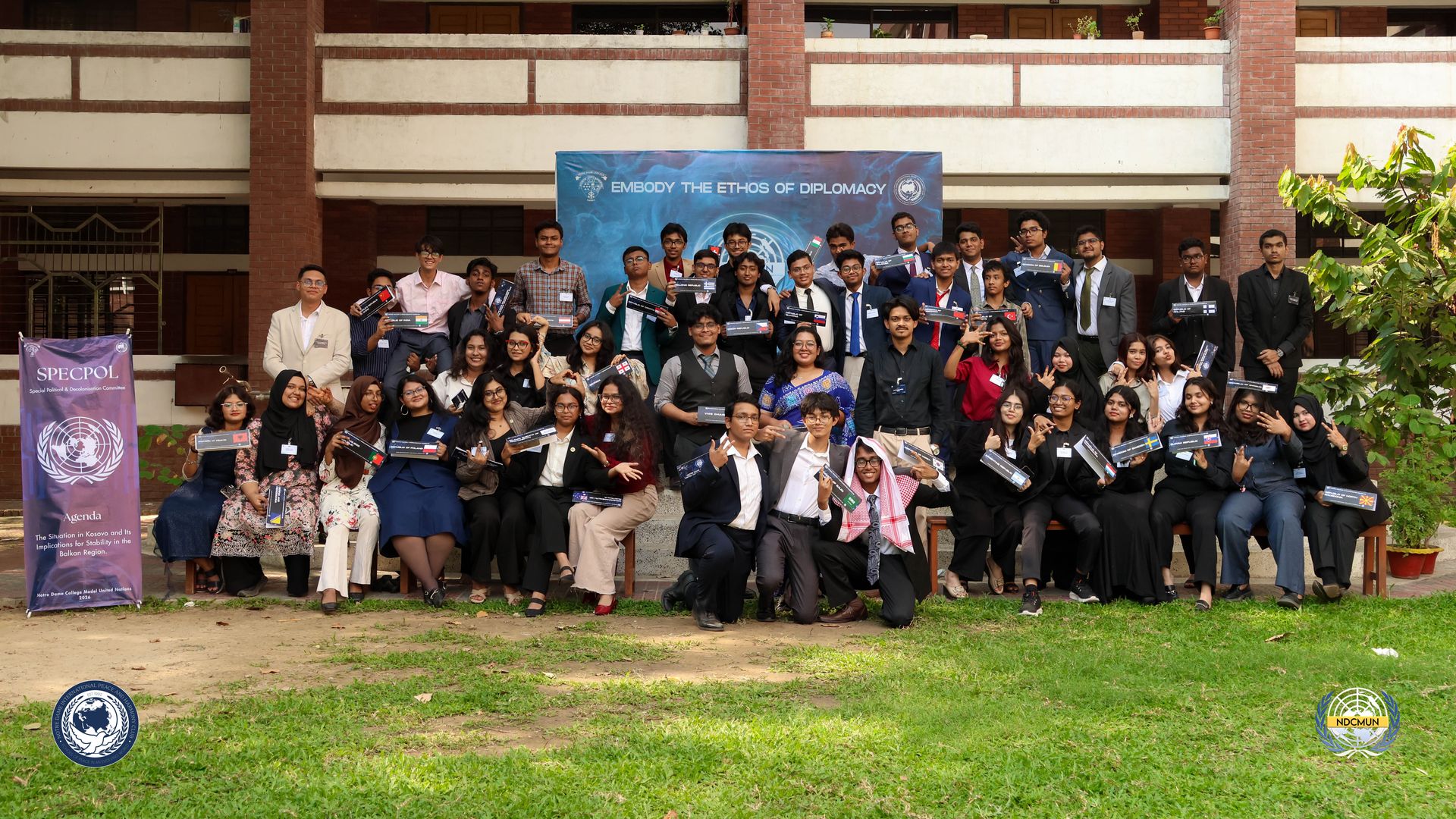
Kosovo — one of international law's most enduring fault lines — gave SPECPOL its defining tension. Serbia and Russia held firm against any language that might legitimise the 2008 Declaration of Independence, while the United States, United Kingdom, and EU delegations defended self-determination with equal conviction. The positions were predictable; the debate was anything but.
Day two's moderated caucus on minority rights and inter-ethnic dynamics produced some of the most quietly powerful speeches of the entire conference. Negotiations on the final day stumbled — the first Draft Resolution collapsed under the weight of irreconcilable language. The committee persisted. A revised resolution, surgically worded to address Balkan regional stability without adjudicating Kosovo's contested status, finally passed — a diplomatic achievement the Executive Board praised for its nuance and realism.
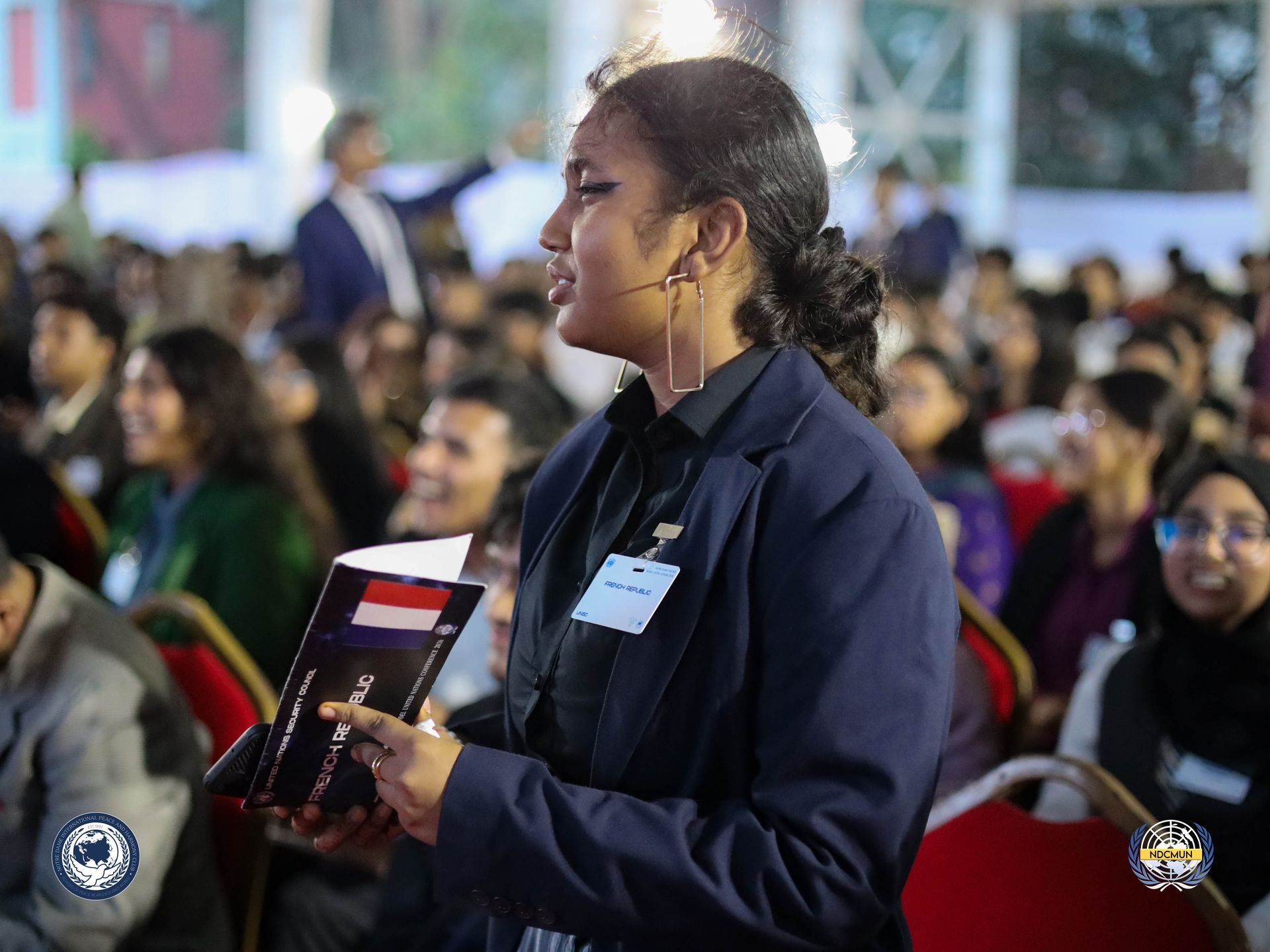
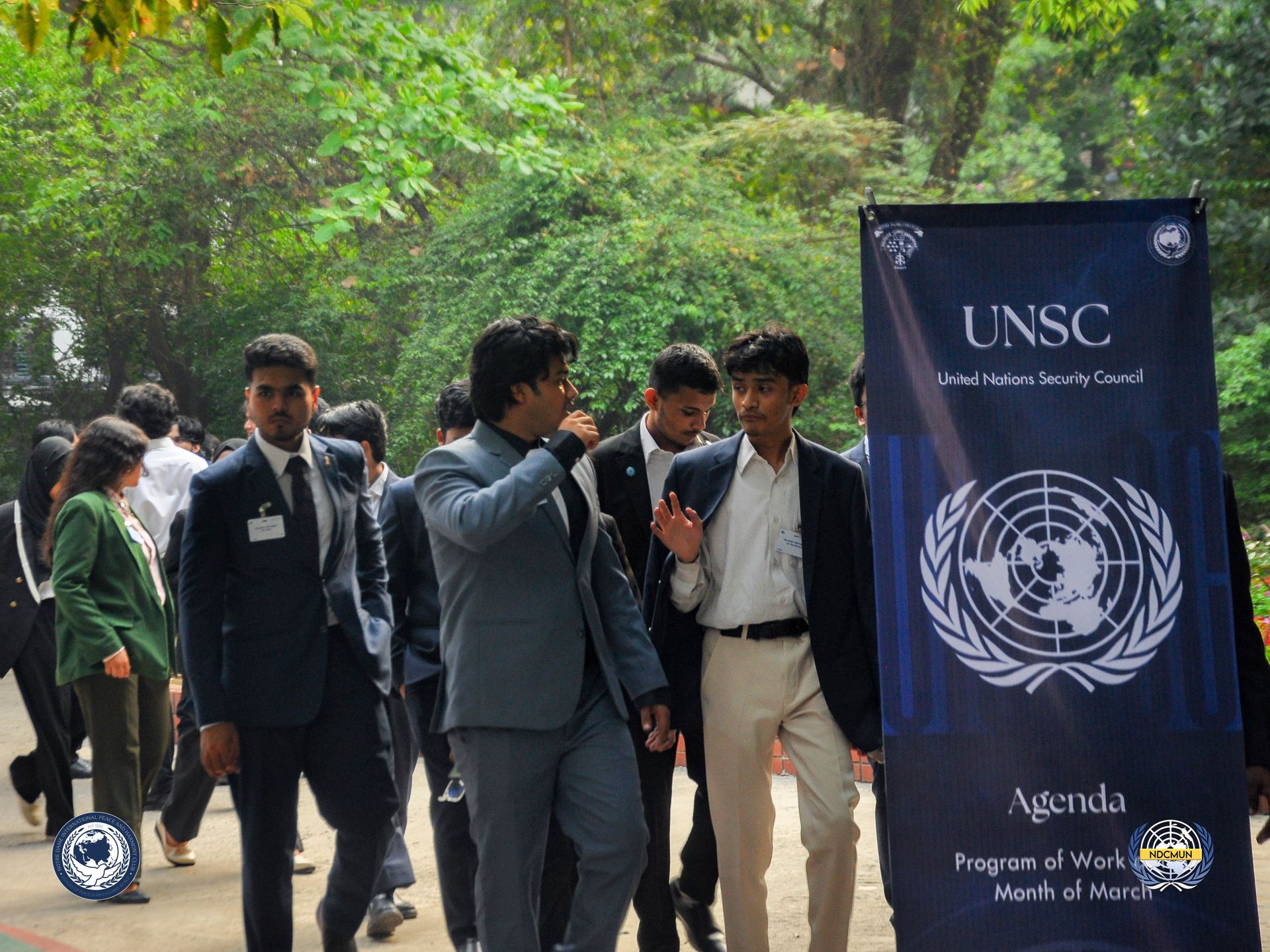
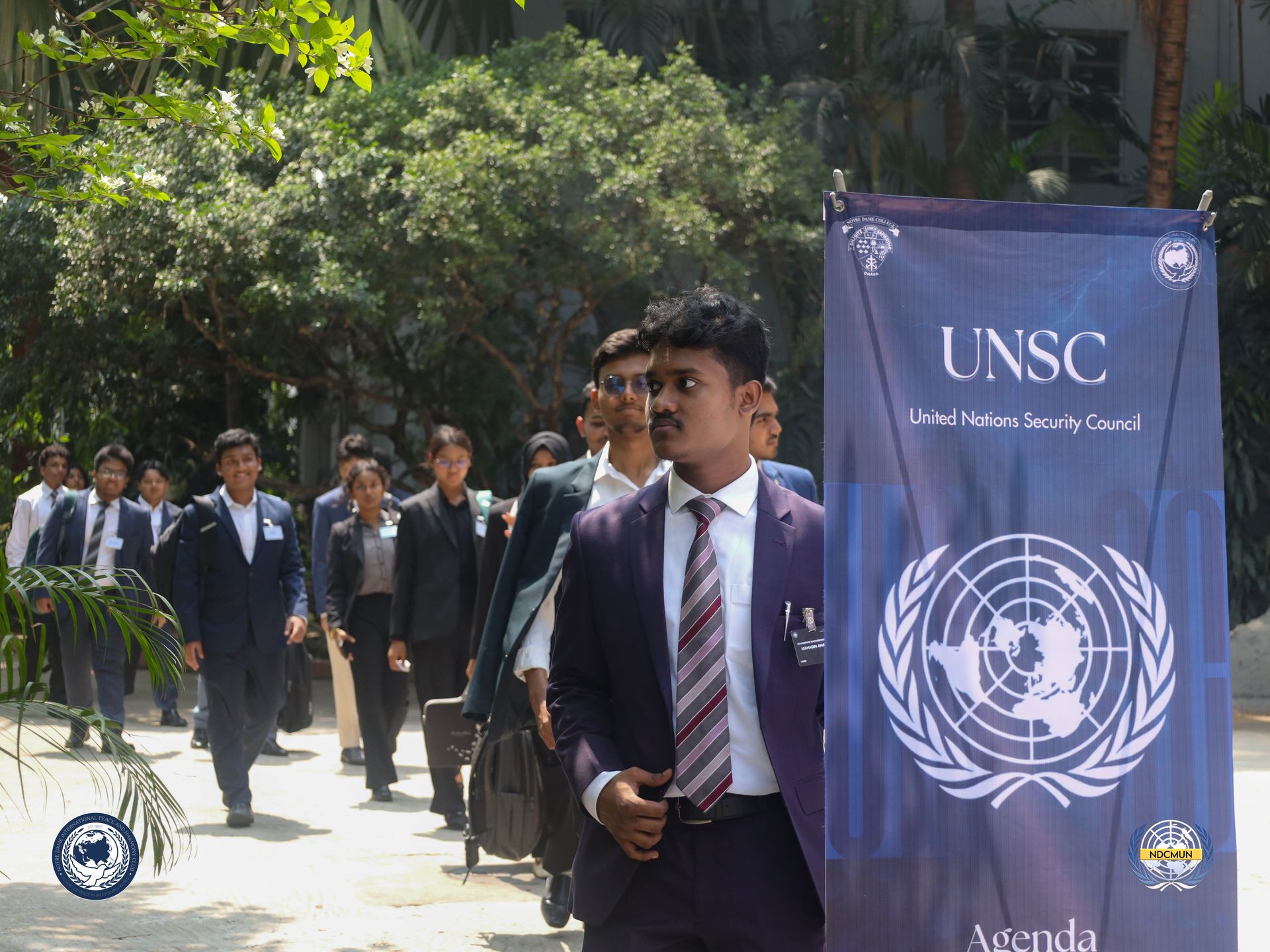
The Security Council at NDCMUN'26 operated differently from every other committee in the building — a rolling crisis format that swept delegates from one global flashpoint to the next with barely time to breathe. The P5 dynamic was on full, uncomfortable display: the United States and China at permanent loggerheads, Russia wielding its veto as a surgical instrument of delay, France and the UK pushing for humanitarian action at every turn.
Day one saw the Council grapple with an escalating humanitarian corridor dispute. Day two's surprise crisis injection — a maritime security incident in the Indo-Pacific — forced a full pivot, testing the room's institutional memory and procedural agility simultaneously. Vetoes were cast. Back-channel deals collapsed. But in the final session, the Council produced a Presidential Statement on ceasefire monitoring — a hard-won, carefully hedged consensus that, in the way of real Security Council outcomes, satisfied nobody completely and everybody just enough.
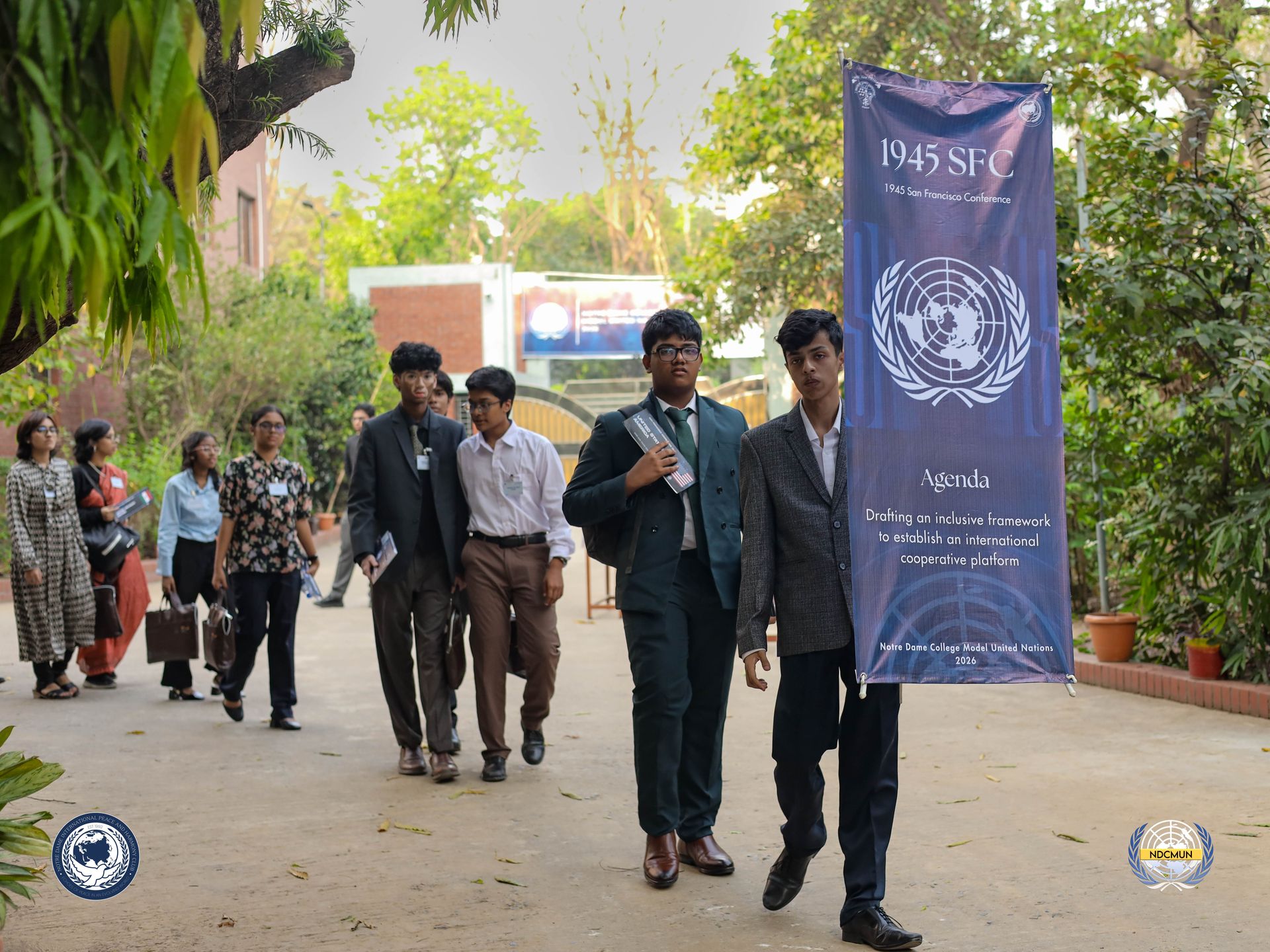
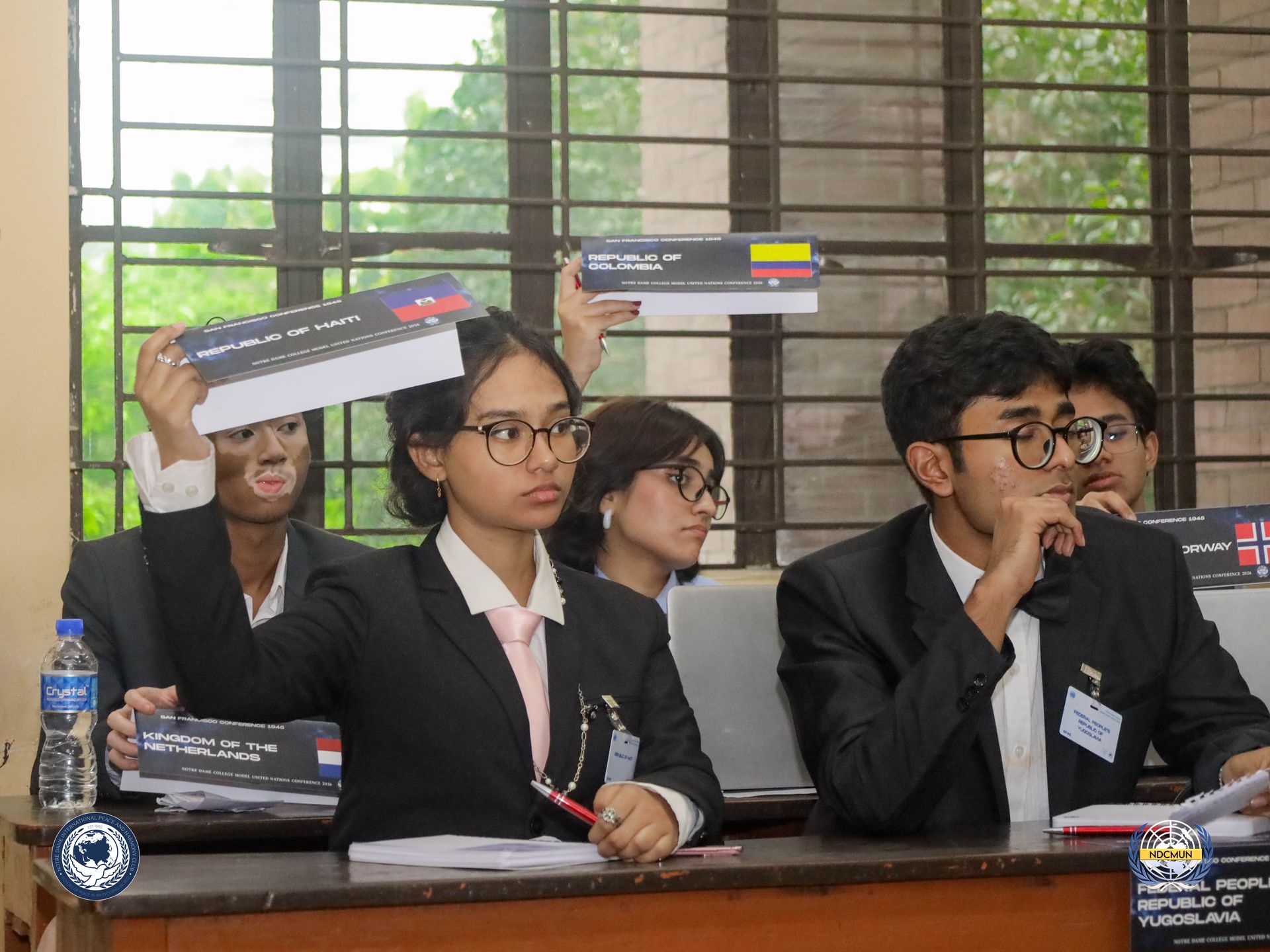
Of all the rooms at NDCMUN'26, the San Francisco 1945 Committee was the one that dared to rewrite history — and it delivered spectacularly. Delegates rewound the clock to April 1945 and set about building the United Nations from scratch, debating every article, every clause, every compromise the original founders faced in San Francisco eighty years ago.
Chapter VI was substantially reworked. The "Permanent 5" was abolished and replaced with a "Veto 5" — a conceptually distinct formulation that sparked fierce debate about great-power accountability. The committee aimed to build a Charter that would function as a genuine mechanism for peace rather than, as one delegate put it, "a glorified document."
The most dramatic moment came when French media reported that the V5 nations had secretly agreed to a covert diplomatic arrangement through back channels — throwing the room into chaos. The report was later dismissed as fabricated. The final Charter, authored collectively by all participating nations, was presented at close of conference to a room that had spent three extraordinary days earning every word of it.
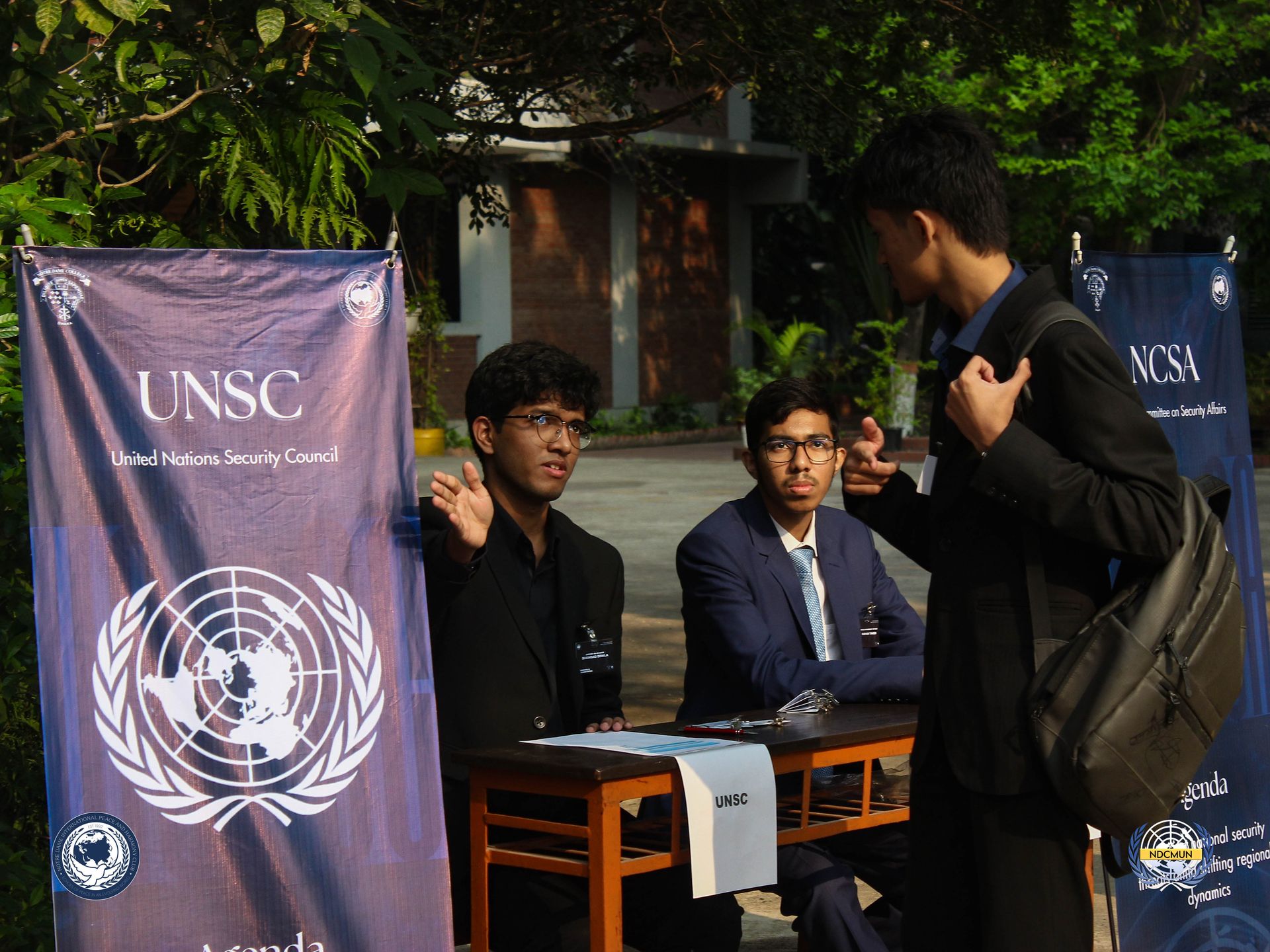
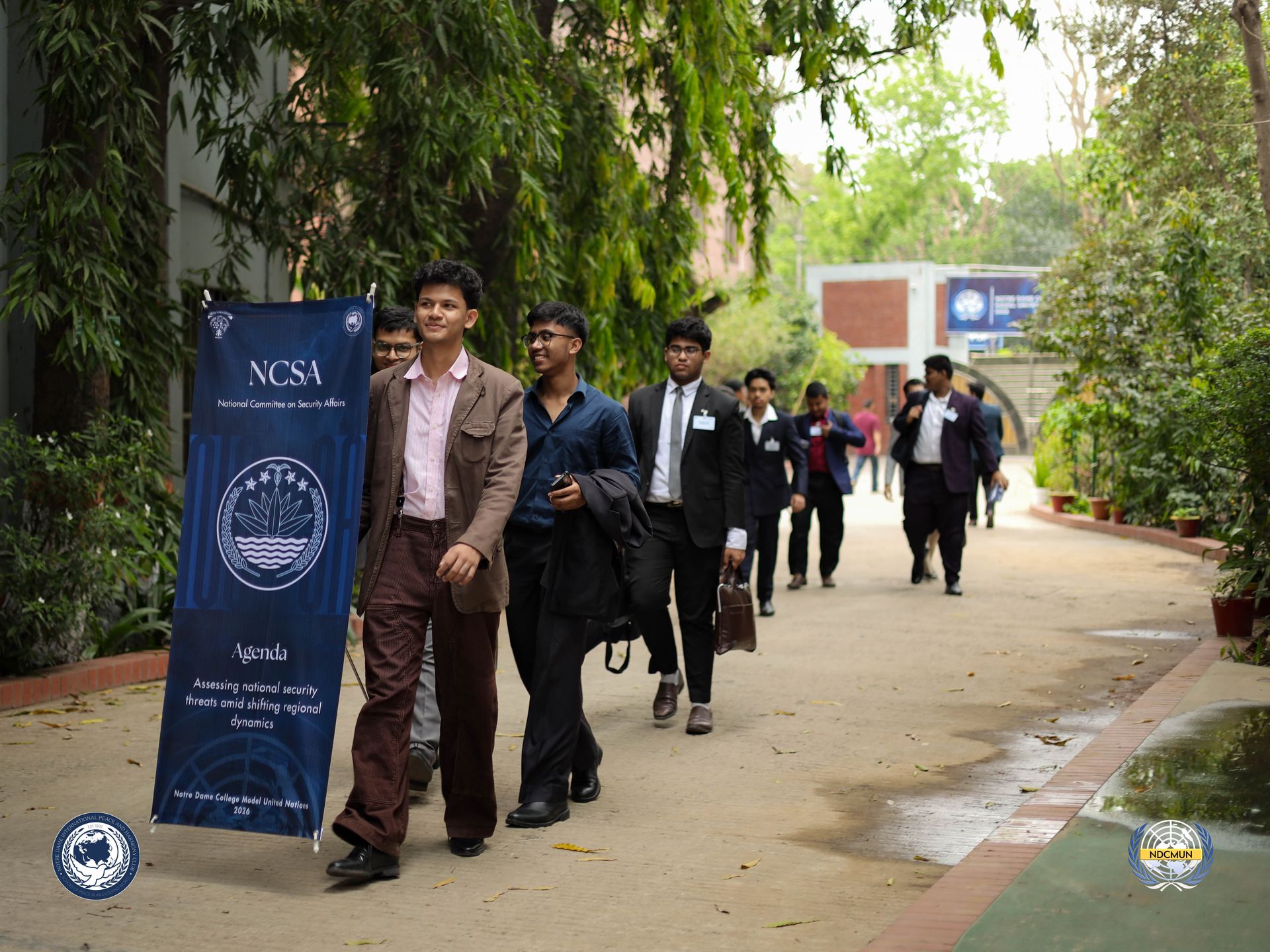
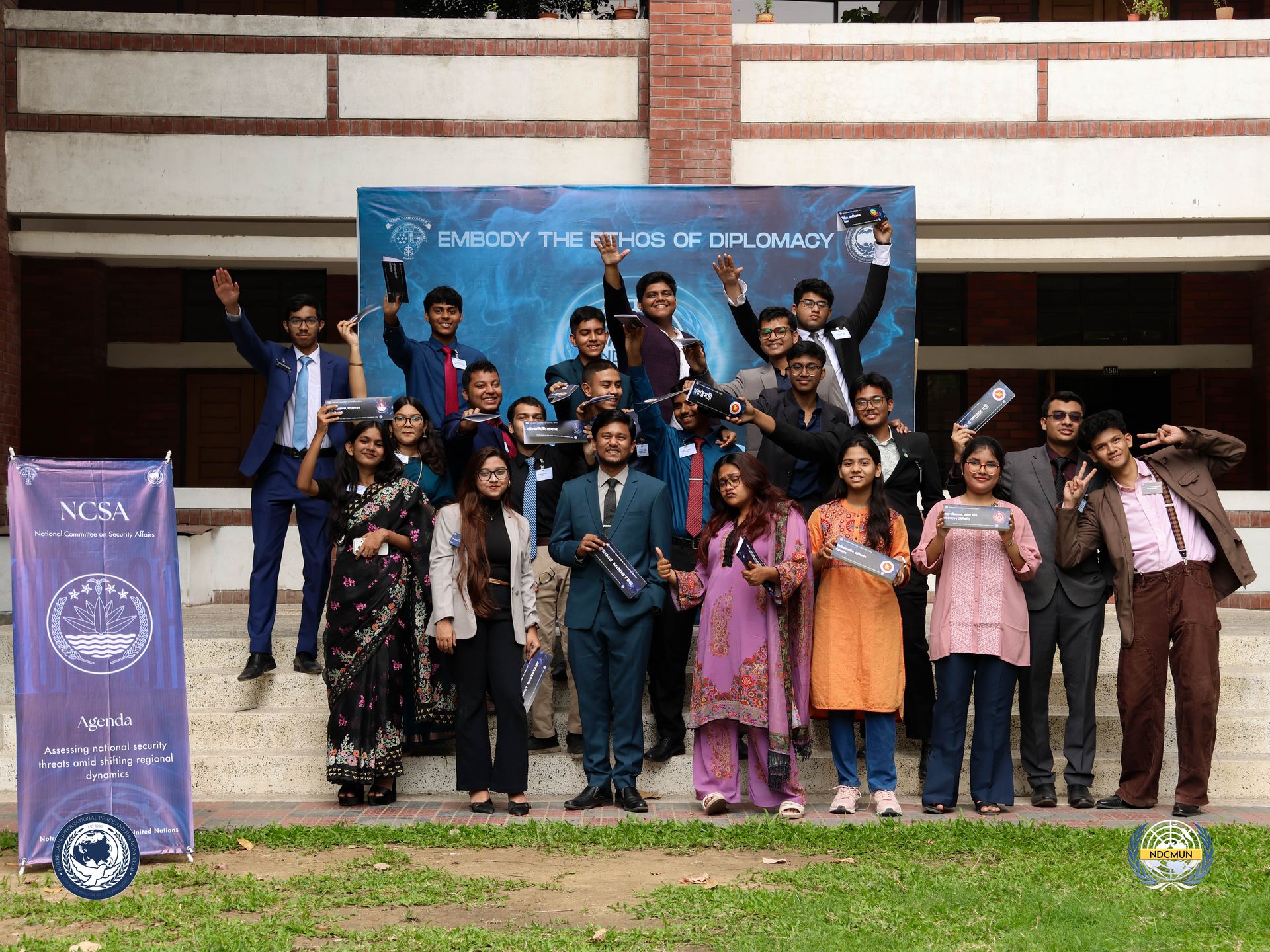
The NCSA was NDCMUN'26's most grounded committee — and perhaps its most urgent. Rather than simulating events in Geneva or New York, the ministers and bureaucrats in this room were dealing with Bangladesh: the fuel crisis, the Rohingya crisis, Indo-Bangladeshi border killings, cybersecurity threats, and the structural weight of regional geopolitical influence.
Day two's two primary discussions — one on cybersecurity, one focused squarely on India's influence on Bangladesh's security landscape — generated some of the sharpest strategic thinking of the conference. Day three brought the Rohingya crisis and national economic precarity back to centre stage. The committee concluded with every member co-authoring a Cabinet Report: a comprehensive policy document presenting actionable resolutions across all major security domains. It was exactly the kind of output that makes specialised committees worth running — grounded, contextualised, and distinctly Bangladeshi in its stakes.
When delegates describe NDCMUN'26 as the "grandest institutional MUN," they are not speaking loosely. Over three days, twelve committees navigated the world's most complex policy questions — climate finance and CBRN threats, press freedom and Balkan sovereignty, the founding of the United Nations and the unfinished justice of 1971. They argued, negotiated, amended, voted, and occasionally failed — and in that failure, learned precisely what diplomacy demands of those who practice it.
The 8th edition of Notre Dame College Model United Nations has set a standard. The debates will be remembered. The resolutions will be studied. And the delegates who filled these chambers over three relentless March days have taken something with them that no gavel can adjourn.
NDCMUN'26. Concluded. Unforgettable.
The Grandest Institutional MUN
Has Spoken
NDCMUN'26 concludes its 8th edition — 430+ delegates, 12 committees, three days of debate that redrew the map of collegiate Model UN in Bangladesh.
When the gavel fell for the final time at Notre Dame College Model United Nations 2026, it marked the close of what many delegates are already calling the defining institutional MUN of a generation. The 8th edition of NDCMUN drew over 430 participants from across the country — and across three days of relentless debate, crisis sessions, courtroom drama, and historic charter-writing, it did not disappoint.
Twelve committees. Twelve agendas spanning everything from tariff wars and climate finance to the 1945 founding of the United Nations itself. From the moot courtroom of the International Crimes Tribunal to the backroom diplomacy of the San Francisco Conference, NDCMUN'26 ran the full spectrum of what Model UN can be — and then pushed further. The academics were, by nearly universal delegate consensus, absolutely astounding.
This is the story of how it unfolded.
If NDCMUN'26 had a political heartbeat, it pulsed loudest in ECOSOC. The committee convened against the backdrop of the sweeping tariff regime introduced by the United States since 2025 — and delegates wasted no time making their positions known. The Russian Federation and the Eastern Bloc came out swinging, levelling pointed accusations that Washington's trade policies amounted to a deliberate attempt to engineer a global recession.
Day one grounded delegates in the stakes with a structured case study on the agenda's real-world dimensions. The second day shifted gears dramatically with a live crisis session — and it was Iran, Pakistan, and China who stepped up, forging a Joint Directive that steered the room back from the brink. The final day brought two competing Draft Resolutions: one authored by China and Saudi Arabia, another co-authored by the UK and Canada. Despite Britain's spirited attempt to amend the China–Saudi resolution into something more palatable to the Western bloc, it held — and passed. A decisive win for the Eastern coalition.
"The Russian Federation accused the USA of trying to bring about a global recession — and the chamber never quite recovered its composure."
With 45 delegates assembled and one of the world's most urgent humanitarian crises on the table, the UNHRC became a chamber of genuine moral weight. Sudan's ongoing internal conflict — its staggering human cost, its fractured accountability mechanisms — drove three days of exhaustive moderated sessions and consultations, with standout contributions from the Swiss Confederation, UAE, Sudan, USA, and the Democratic Republic of Congo.
The culmination was a landmark Draft Resolution co-sponsored by Switzerland, China, and the DRC, backed by over 26 signatories. At its heart, Annex I laid out six robust sections under the Integrated Reform Points for the Independent International Fact-Finding Mission for Sudan — covering accountability mechanisms, a Survivor and Civil Society Chamber, Geneva-based evidence preservation units, and comprehensive implementation oversight. It passed as a testament to what careful multilateral negotiation can produce.
The OIC's General Speakers' List was one of the most incendiary of the conference. Delegations from across the Muslim world traded blame and pointed accusations over the "current state of the Ummah" — the speeches were heated, charged, and at times deeply personal in their geopolitical framing.
Day two cooled into structured negotiation, with three consultations across formal and informal sessions. Day three opened with the first Draft Resolution — co-authored by Saudi Arabia, Türkiye, Azerbaijan, and Pakistan — but it failed to secure a majority and was rejected. A fresh twenty-minute unmoderated caucus produced a second resolution, this time led by Jordan. After a tense amendment session, Jordan's resolution crossed the line and passed — a reminder that in multilateral diplomacy, adaptability consistently outperforms raw firepower.
Forty members of Congress. One president. One constitutional crisis. The Joint US Congress at NDCMUN'26 was a full historical immersion — delegates locked into the world of 1973, bound by its timeline, its evidence, and its political fault lines. Republicans and Democrats clashed in what observers called "heated and fruitful" congressional debate, the kind that made the chamber feel less like a simulation and more like a revival of one of American history's most consequential moments.
After exhaustive hearings — witnesses examined, evidence scrutinised, testimonies cross-checked — the Congress reached consensus. Four Articles of Impeachment were drafted and adopted, sealing the fictional fate of the 37th President of the United States. The result was historically faithful, dramatically satisfying, and a showcase of how a well-run specialised committee transforms procedural rigour into genuine theatre.
DISEC took on one of the most technically demanding briefs of the conference — chemical, biological, radiological, and nuclear threats across the world's most geopolitically volatile region. The General Speakers' List immediately exposed fault lines: nuclear-armed states faced sharp scrutiny from NPT signatories, with North Korea and Pakistan drawing particular attention from the floor.
A crisis injection on day two — a simulated radiological incident in the South China Sea — galvanised the committee, pushing delegates into rapid-fire unmoderated caucuses. China, Japan, and Australia emerged as the dominant bloc leaders. The final day produced two competing Draft Resolutions: one from the United States and Australia, another from China and Russia. A contentious amendment session produced a merged text incorporating regional verification mechanisms and an early-warning protocol — passed with a strong majority, and widely considered one of the conference's most substantive legislative outputs.
The UNFCCC committee demanded more technical literacy than perhaps any other room at NDCMUN'26 — and its delegates rose to the challenge. The agenda centred on translating the political promises of COP28 and COP29 into real financial architecture: disbursement criteria, governance structures, and contribution thresholds under the New Collective Quantified Goal framework.
Small Island Developing States and Least Developed Countries formed a powerful coalition on day one, demanding direct access mechanisms and rejecting financial intermediaries. The EU and G77+China bloc spent much of day two in intricate contribution negotiations. On the final day, Bangladesh, the Maldives, and Germany co-authored a Draft Resolution establishing a tiered contribution model alongside an independent review board — a carefully grounded package that passed to genuine applause, and one that carried particular resonance in a conference hosted in one of the world's most climate-vulnerable nations.
"The academics were absolutely astounding — making this, by delegates' own reckoning, the grandest institutional MUN the country has seen."
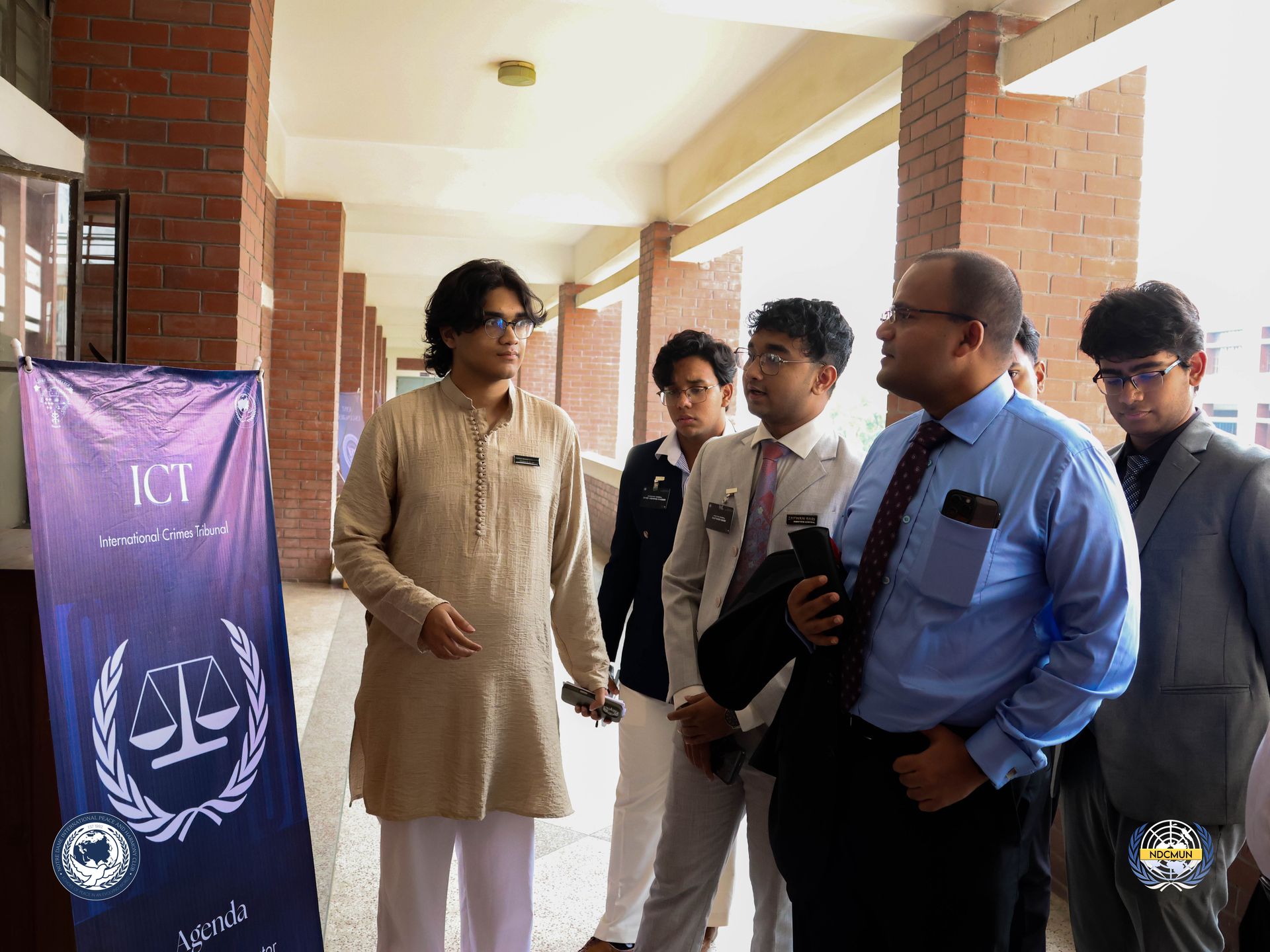
The ICT was NDCMUN'26's moot court — and it proved to be among the most gripping chambers of the entire conference. The case revisited the landmark trial of Salahuddin Quader Chowdhury, charged with genocide, murder, rape, and torture committed during Bangladesh's 1971 Liberation War.
The prosecution built its case on placing Chowdhury in Raozan, Chattogram, at the time of the alleged crimes. The defence countered with witnesses and evidence claiming he was in Lahore, West Pakistan — making his presence at the scene physically impossible. But the alibi unravelled: the tribunal identified critical discrepancies between the defendant's testimony and the submitted evidence, discarding the defence's materials as forgeries and fining the defence counsel accordingly.
In their final judgement, the tribunal found it could neither fully accept nor fully reject the plea of alibi — but on the weight of the evidence, it convicted Salahuddin Quader Chowdhury of murder and rape, sentencing him to 17 years imprisonment, while acquitting him on the charge of genocide. A verdict that balanced legal complexity with moral clarity — and left the chamber in hushed reflection.
The IPC brought a singular energy to NDCMUN'26 — a chamber where free expression was both the subject of debate and its most powerful instrument. Delegates representing states with wildly divergent press freedom records clashed from the opening gavel, with Turkey, Hungary, and Egypt facing sustained criticism from Nordic delegations and Canada over their treatment of the press.
Day one's speeches drew on real-world cases of persecution, exile, and targeted killing — some of the conference's most emotionally forceful oratory. A crisis update on day two introduced a simulated abduction of a journalist covering a conflict zone, sharply intensifying the debate around state accountability and international protection frameworks. The resolution that emerged — co-sponsored by France, the Netherlands, and Costa Rica — proposed an international journalist protection registry and a rapid-response legal support mechanism. It passed by a close vote, a reflection of just how contested and consequential the question of press liberty remains.
Kosovo — one of international law's most enduring fault lines — gave SPECPOL its defining tension. Serbia and Russia held firm against any language that might legitimise the 2008 Declaration of Independence, while the United States, United Kingdom, and EU delegations defended self-determination with equal conviction. The positions were predictable; the debate was anything but.
Day two's moderated caucus on minority rights and inter-ethnic dynamics produced some of the most quietly powerful speeches of the entire conference. Negotiations on the final day stumbled — the first Draft Resolution collapsed under the weight of irreconcilable language. The committee persisted. A revised resolution, surgically worded to address Balkan regional stability without adjudicating Kosovo's contested status, finally passed — a diplomatic achievement the Executive Board praised for its nuance and realism.
The Security Council at NDCMUN'26 operated differently from every other committee in the building — a rolling crisis format that swept delegates from one global flashpoint to the next with barely time to breathe. The P5 dynamic was on full, uncomfortable display: the United States and China at permanent loggerheads, Russia wielding its veto as a surgical instrument of delay, France and the UK pushing for humanitarian action at every turn.
Day one saw the Council grapple with an escalating humanitarian corridor dispute. Day two's surprise crisis injection — a maritime security incident in the Indo-Pacific — forced a full pivot, testing the room's institutional memory and procedural agility simultaneously. Vetoes were cast. Back-channel deals collapsed. But in the final session, the Council produced a Presidential Statement on ceasefire monitoring — a hard-won, carefully hedged consensus that, in the way of real Security Council outcomes, satisfied nobody completely and everybody just enough.
Of all the rooms at NDCMUN'26, the San Francisco 1945 Committee was the one that dared to rewrite history — and it delivered spectacularly. Delegates rewound the clock to April 1945 and set about building the United Nations from scratch, debating every article, every clause, every compromise the original founders faced in San Francisco eighty years ago.
Chapter VI was substantially reworked. The "Permanent 5" was abolished and replaced with a "Veto 5" — a conceptually distinct formulation that sparked fierce debate about great-power accountability. The committee aimed to build a Charter that would function as a genuine mechanism for peace rather than, as one delegate put it, "a glorified document."
The most dramatic moment came when French media reported that the V5 nations had secretly agreed to a covert diplomatic arrangement through back channels — throwing the room into chaos. The report was later dismissed as fabricated. The final Charter, authored collectively by all participating nations, was presented at close of conference to a room that had spent three extraordinary days earning every word of it.
The NCSA was NDCMUN'26's most grounded committee — and perhaps its most urgent. Rather than simulating events in Geneva or New York, the ministers and bureaucrats in this room were dealing with Bangladesh: the fuel crisis, the Rohingya crisis, Indo-Bangladeshi border killings, cybersecurity threats, and the structural weight of regional geopolitical influence.
Day two's two primary discussions — one on cybersecurity, one focused squarely on India's influence on Bangladesh's security landscape — generated some of the sharpest strategic thinking of the conference. Day three brought the Rohingya crisis and national economic precarity back to centre stage. The committee concluded with every member co-authoring a Cabinet Report: a comprehensive policy document presenting actionable resolutions across all major security domains. It was exactly the kind of output that makes specialised committees worth running — grounded, contextualised, and distinctly Bangladeshi in its stakes.
When delegates describe NDCMUN'26 as the "grandest institutional MUN," they are not speaking loosely. Over three days, twelve committees navigated the world's most complex policy questions — climate finance and CBRN threats, press freedom and Balkan sovereignty, the founding of the United Nations and the unfinished justice of 1971. They argued, negotiated, amended, voted, and occasionally failed — and in that failure, learned precisely what diplomacy demands of those who practice it.
The 8th edition of Notre Dame College Model United Nations has set a standard. The debates will be remembered. The resolutions will be studied. And the delegates who filled these chambers over three relentless March days have taken something with them that no gavel can adjourn.
NDCMUN'26. Concluded. Unforgettable.
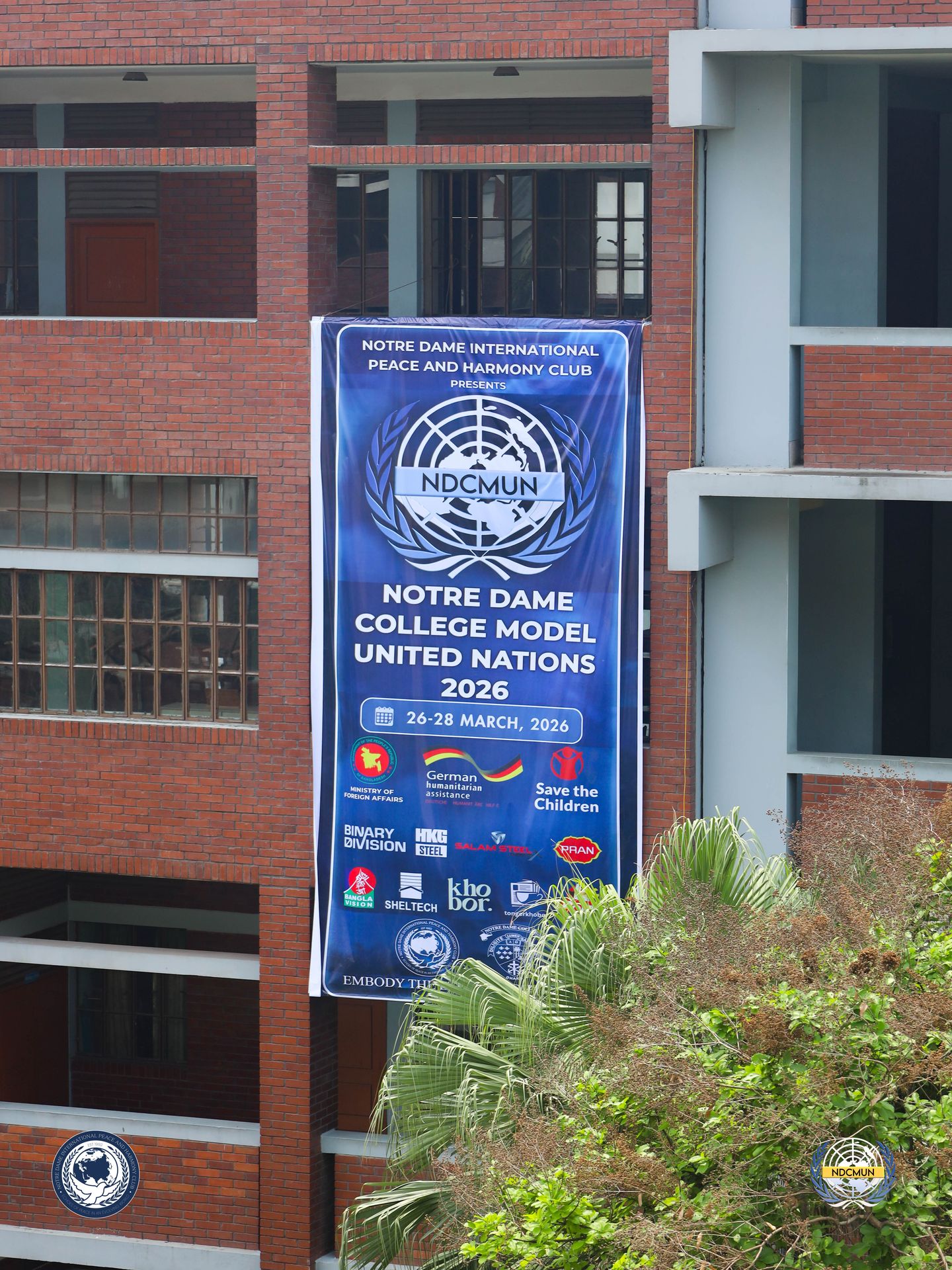
our strategic partners
ministry of foreign affairs, gob
As our primary institutional patron, the Ministry of Foreign Affairs, Government of the People's Republic of Bangladesh, provides the essential diplomatic framework for NDCMUN. This partnership bridges the gap between academic simulation and real-world statecraft, ensuring our delegates engage with the highest standards of international relations.

save the children
Our collaboration with Save the Children emphasizes the core UN value of protecting the world’s most vulnerable populations. By integrating their global expertise into our committee agendas, we empower delegates to draft resolutions that are not only theoretically sound but also grounded in the urgent humanitarian realities of child rights and welfare.
german humanitarian assistance
Supported by the Federal Foreign Office of Germany, this partnership brings a focus on global crisis response and sustainable relief. German Humanitarian Assistance serves as a vital resource for our specialized committees, offering delegates a perspective on how international aid is mobilized to save lives and alleviate suffering in conflict zones and climate-affected regions.
ndcmun 2026 gallery